The shift toward local AI execution is emerging as the defining trend in modern computing. The era of absolute reliance on cloud services is gradually giving way to the rise of high-performance edge systems, which guarantee data privacy and near-zero latency. Acer's latest unveilings at IFA 2026 vividly illustrate two distinct trajectories for this evolution: one leading toward the development of ultra-powerful nodes for autonomous agents, and the other toward the seamless integration of AI into everyday professional workflows.
The hardware market is currently undergoing a fundamental paradigm shift: computational power is migrating from remote data centers directly to the user's desktop. This transition is driven by the urgent need to reduce inference latency and stringent security requirements that render cloud computing non-viable for many enterprise-level tasks. In this context, Acer's latest developments represent a strategic attempt to provide the market with two fundamentally different toolsets for interacting with artificial intelligence.
The boldest offering is the SFF RTX Spark, a compact desktop designed to condense enterprise-grade server capabilities into a small form factor. At the heart of the system lies the RTX Spark "superchip," which integrates a Blackwell RTX GPU featuring 6,144 cores with a 20-core Nvidia Grace CPU. This synergy enables performance levels of up to one petaflop, transforming the computer from a simple endpoint into a fully realized workstation for deploying and training local AI agents.
Particular attention must be paid to the memory capacity, which reaches up to 128 GB. In deep learning and Large Language Model (LLM) workflows, VRAM capacity and bus bandwidth are the primary critical bottlenecks. The integration of the Grace architecture with Blackwell allows for highly efficient data management, minimizing idle time for the compute cores.
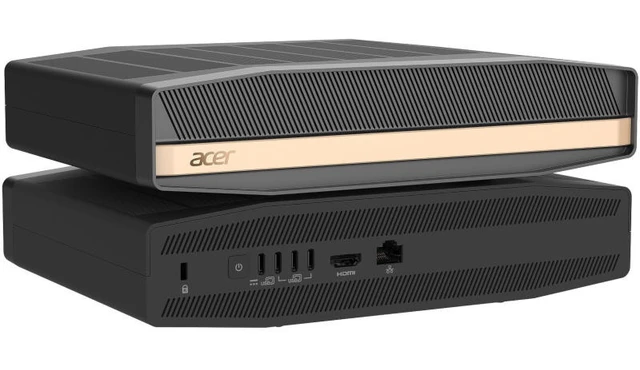
Parallel to this, Acer has introduced the Veriton RI110 AI workstation, which pursues a different philosophy: deep integration and streamlined optimization. Here, the focus is on the Intel platform, specifically the Core Ultra X7 358H processor and Intel Arc B390 graphics. Unlike the RTX Spark, which is engineered for heavy-duty computation, the Veriton is tailored for daily professional productivity.
This model fully adheres to the Microsoft Copilot+ PC specifications. This means the hardware is optimized for native Windows features, such as intelligent search, automated text summarization, and real-time content generation. In this ecosystem, the key is not so much brute force as it is the presence of dedicated Neural Processing Units (NPUs). These allow basic AI tasks to be executed with minimal power consumption without overloading the primary GPU or CPU.
The bifurcation of the product line into an Nvidia-powered "high-performance powerhouse" and an Intel-powered "intelligent utility" reflects a broader industry trend. We are witnessing the emergence of two distinct device classes: specialized accelerators for AI developers and researchers, and universal workstations where neural networks become as ubiquitous a tool as a word processor or a web browser.
 The Horizon of China's Technological Sovereignty in Lithography