The PC industry is undergoing a fundamental pivot toward energy-efficient Arm-based architectures. This transition to new computing standards necessitates a complete reimagining of workstation form factors and functionality. Asus meets this challenge with the launch of the Ascent QN10—a device that evolves the mini-PC concept into a powerful tool for local AI inference and neural network processing. It represents a strategic leap forward for the Copilot+ PC ecosystem, proving that high-end performance no longer demands cumbersome cooling solutions.
At the core of the Ascent QN10 lies the Qualcomm Snapdragon X2 Elite. Far more than a mere iterative update, this processor represents a paradigm shift in computing, featuring an 18-core module powered by third-generation Oryon cores. While the Adreno X2-90 graphics subsystem ensures a seamless visual experience, the true technological centerpiece is the Qualcomm Hexagon NPU. Delivering up to 80 TOPS in INT8 operations, this NPU comfortably clears the benchmark set by Microsoft for Copilot+ PCs, paving the way for deep integration of intelligent features directly within the Windows-on-Arm ecosystem.
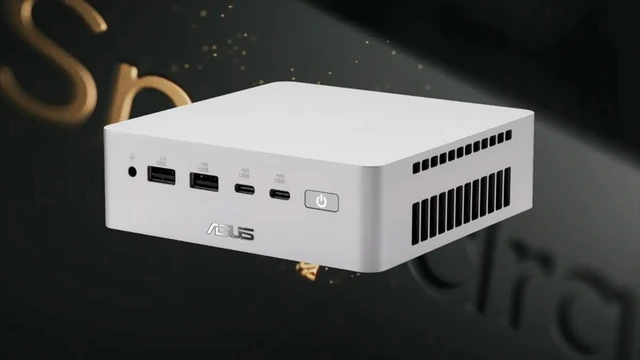
The engineering behind the chassis reflects a commitment to extreme minimalism: with a volume of less than 0.7 liters and a weight of 620 grams, the device maintains a negligible desktop footprint without compromising on performance. Within this compact frame, the system supports high-speed LPDDR5X-9600 memory with capacities up to 32 GB. Particularly noteworthy is the flexibility of the storage subsystem; the inclusion of a PCIe 5.0 M.2 2280 slot, complemented by an additional PCIe 4.0 slot, allows for expansion up to 4 TB. This transforms the mini-PC into a formidable archive or a dedicated workstation for big data processing.
The Ascent QN10’s I/O array is meticulously designed for professional workflows. Three USB4 Type-C ports, boasting 40 Gbps throughput, ensure lightning-fast data transfers and compatibility with next-generation peripherals. Additional USB Type-A ports and an HDMI 2.1 interface enable the deployment of a full-scale workspace supporting four 4K displays—a rarity for a device of this form factor. A modern wireless stack, featuring Wi-Fi 7 and Bluetooth 6.0, guarantees connection stability even in congested RF environments.
The economic entry point into this ecosystem begins at approximately $1,350 for the base configuration, equipped with 16 GB of RAM and a 512 GB SSD. Higher-performance variants with expanded memory and storage options provide a flexible scaling path tailored to specific user requirements.
It is critical to recognize that the Ascent QN10 does not position itself as a gaming console. Its true purpose lies in the development and local execution of artificial intelligence models. Integration with the Qualcomm AI Hub—which provides access to hundreds of optimized models—allows for the deployment of complex applications such as OpenClaw and Hermes Agent without relying on cloud services. This ensures not only data privacy but also minimal latency, effectively turning this compact computer into an autonomous intelligence hub.
 Breaking the Lithography Barrier in China