The contemporary open-source landscape is dominated by two extremes: corporate behemoths and monolithic distributions governed by rigid hierarchies. Yet, independent ventures like Mageia persist in demonstrating that community-driven passion can sustain a fully realized, professional-grade operating system. The launch of version 10 marks a new milestone in the evolution of this Mandriva successor—a project relentlessly pursuing technical excellence and rock-solid stability. This release is far more than a routine package update; it represents a profound overhaul of the system's fundamental management mechanisms.
Mageia's origins trace back to 2010, emerging as a direct response to the internal crisis at Mandriva. Founded by former employees of the company, the project became the embodiment of a core philosophy: that an operating system should belong to the community rather than commercial entities. While retaining many of its predecessor's hallmarks, Mageia has evolved over the years into a mature, independent product. With its tenth version, the distribution takes a significant leap forward in modernizing its underlying infrastructure.
The technological stack of Mageia 10 is underpinned by Linux kernel 6.4.3, ensuring broad compatibility with contemporary hardware. This update touches every critical node: from the GCC 12.3.0 compiler and glib 2.36 library to package management systems RPM 4.18.0 and the optional DNF 4.14.0. Users have access to up-to-date application software, including Firefox ESR 102.13 and LibreOffice 7.5.4.2, alongside current releases of key programming languages: Python 3.10.11, Ruby 3.1.4, and Rust 1.70.
Particular attention has been paid to the graphical user interfaces. The distribution offers an impressive array of desktop environments, ranging from the feature-rich and powerful KDE Plasma 5.27.5 and GNOME 44.2 to lightweight alternatives like Xfce 4.18.4, MATE 1.26.0, and LXQt 1.3.0. Even support for LXDE has been maintained, underscoring the project's commitment to ensuring system accessibility on legacy or resource-constrained hardware.
However, the release's primary technical achievement is the migration of the package database (rpmdb) from BerkeleyDB to SQLite. This transition was driven not only by licensing concerns—the shift of Berkeley DB 6 to AGPLv3 created legal complexities—but also by reliability. The previous implementation lacked transactional integrity, which occasionally led to database inconsistencies. The adoption of SQLite makes package management more stable and predictable.
Optimizations have also extended to content delivery processes. Urpmi images and metadata are now compressed using the Zstd algorithm, which significantly outperforms Xz in terms of speed. Furthermore, the installer now utilizes curl instead of wget, expanding package download capabilities. For those who value minimalism, the base installation footprint has been noticeably reduced by excluding recommended but non-essential components.
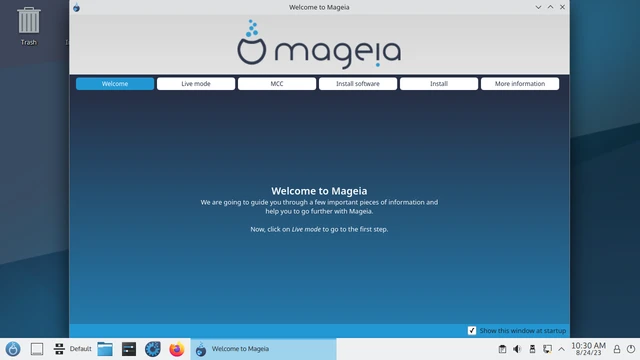
The user experience (UX) has been overhauled at the interaction level. The MageiaWelcome application, which greets users upon their first boot, now features a linear structure, transforming system setup into a sequential and intuitive process. Similarly, the Isodumper utility for image writing and the draklive2 tool have been updated to simplify the configuration of localization, time zones, and firewall settings.
For laptop users with hybrid graphics, a vital new utility, Mageia-prime, has been added to enable efficient switching between integrated Intel GPUs and discrete Nvidia accelerators. Regarding audio, the system adopts a flexible approach by pre-installing both PulseAudio and PipeWire. While the former remains active by default, users can easily switch to the modern PipeWire standard via the Mageia Control Center.
Rounding out the improvements are several system tools: PCMemTest has been replaced by the more current Memtest86+ in the ISO images, and a new remove-old-kernels utility has been introduced to automate the cleanup of obsolete Linux kernels. Collectively, these enhancements transform Mageia 10 into a balanced tool where the academic purity of Open Source meets a pragmatic approach to system administration.
 The Price of Acceleration: CXMT’s Rapid Push into Memory