The handheld gaming market is undergoing a profound transformation, pivoting away from raw local processing power toward seamless network accessibility. While the industry has long been locked in a "gigahertz race," a new category of hardware is emerging—one designed to serve as the definitive bridge between the raw power of a desktop rig and total mobility. Lenovo is making a strategic play in this space with the introduction of the Legion Cloud Gaming Handheld C700. This device embodies the "thin client" philosophy for gaming, prioritizing streaming fidelity and ecosystem cohesion above all else.
The contemporary landscape of Android-based handheld gaming has evolved beyond a niche for enthusiasts and emulation purists. While companies like Ayaneo, Anbernic, and Retroid laid the groundwork, the arrival of the Lenovo Legion C700 is a genuine game-changer. Unlike the full-fledged gaming powerhouses of the Legion Go family, this new entry occupies a different market segment. Here, the priority is not standalone processing power, but rather a seamless synergy with the user's primary gaming rig.
At the heart of the device is the proprietary Lenovo Legion Stream technology. The unit ships with a specialized adapter that transforms the console into a sophisticated remote-access terminal. The primary advantage of this approach is the ability to establish a stream without relying on an external network, allowing users to take a full-scale gaming experience on the go or move around the house while maintaining minimal input lag.
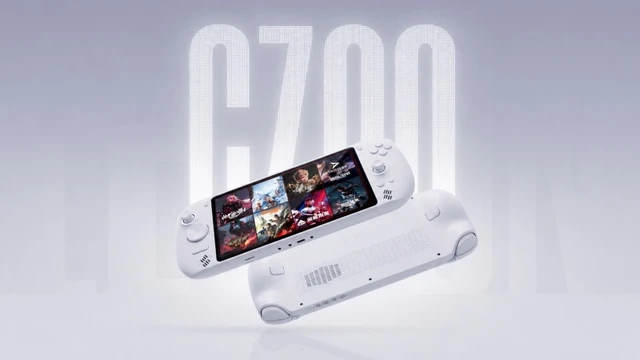
From an ergonomic and aesthetic standpoint, the C700 is a substantial yet meticulously designed device. With a chassis width of nearly 293 mm, it ensures a comfortable grip, while its weight of 556 grams makes it noticeably lighter than the Steam Deck OLED. Visuals are handled by a 7.82-inch LCD display with Full HD resolution. The 120Hz refresh rate is a pivotal specification for streaming devices, as it eliminates visual tearing and ensures a fluidity of motion comparable to native hardware performance.
Under the hood, the Legion C700 is positioned within the budget segment. The system is powered by an octa-core MediaTek Dimensity 7400 chip, supported by active cooling. While this processor doesn't rival flagship silicon, its energy efficiency, paired with a substantial 8,000 mAh battery, enables impressive endurance. Memory configurations range from 6 to 8 GB of RAM and 128 to 256 GB of internal flash storage, with options for expansion.
The input systems deserve particular attention. Lenovo has integrated TMR (Tunnel Magnetoresistance) joysticks, which virtually eliminate "stick drift"—the perennial plague of modern controllers. Hall effect triggers provide tactile precision, while additional rear buttons expand control functionality for complex genres.
However, a deeper technical dive reveals some questionable design choices. Despite supporting the modern Wi-Fi 6E and Bluetooth 5.3 standards, the wired interface is limited to USB 2.0 speeds. In the context of 2026 hardware, such a decision feels anachronistic, significantly bottlenecking data throughput when connecting peripherals or syncing files.
On the software front, the device runs Android 16—an operating system that is currently a rarity in the handheld space. This opens a wide array of possibilities for the user: from running native Android titles and resource-intensive emulators to utilizing full-scale cloud services. Although the Dimensity 7400 isn't the most powerful chip in its class, it is more than sufficient to ensure a stable UI and handle basic tasks.
Currently, the Legion Cloud Gaming Handheld C700 is exclusive to the Chinese market. The high-end configuration, featuring 8 GB of RAM and 256 GB of storage, is priced at 2,199 yuan (approximately $327). While a global release remains unconfirmed, the very existence of such a product confirms the broader industry trend toward the decentralization of computing power in favor of cloud and streaming architectures.
 iPhone 17: Dominating the Global Market