The landscape of Large Language Models (LLMs) is undergoing a fundamental shift, evolving beyond rudimentary chatbots into fully autonomous agents capable of tackling sophisticated engineering challenges. Against this backdrop, the launch of Anthropic’s latest iteration, Claude Opus 5, emerges as a watershed moment, tipping the scales in favor of operational efficiency and broader accessibility. The industry paradigm is pivoting: the obsession with raw parameter counts is giving way to a prioritization of reasoning quality and the capacity for systemic self-correction. This latest evolution of Opus seeks to synthesize uncompromising performance with a streamlined total cost of ownership.
The debut of Claude Opus 5 signals a paradigm shift in the evolution of professional development and automation tools. Anthropic is positioning this model not merely as an incremental update, but as a comprehensive foundation for building long-lived AI agents. The primary strategic vector has been the enhancement of "agentic" capabilities; the model now demonstrates a significantly more profound approach to verifying its own outputs. Rather than applying superficial patches to errors, Opus 5 seeks to identify the root cause of a failure and continues an iterative refinement process even after an initial working solution is found, striving for code perfection.
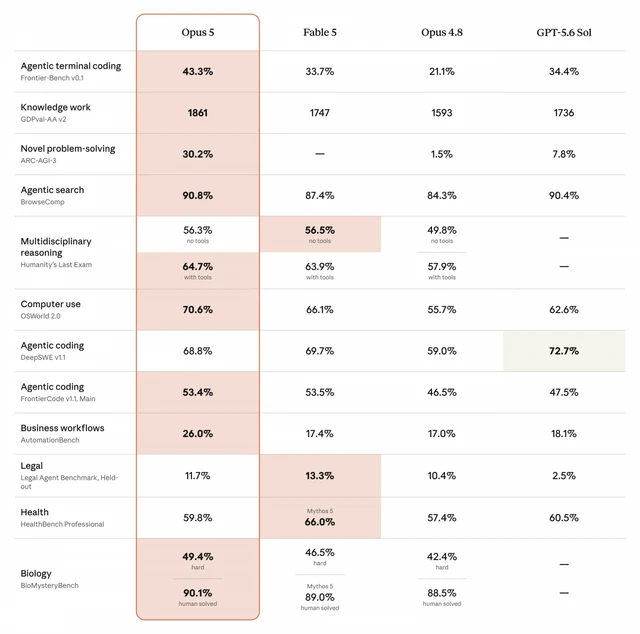
This technical progression is validated by rigorous benchmark metrics, where the model shows impressive momentum. In the SWE-bench Pro test—which simulates real-world software engineering tasks within repositories—Opus 5 has nearly reached parity with Fable 5, posting a result of 79.2% against 80%. An even more striking leap is evident in FrontierBench v0.1: while the previous Opus 4.8 version managed only 18.7% of tasks, the new model has pushed this figure to 44.4%, signaling a qualitative shift in its capacity for complex planning.
Particularly noteworthy is the model's success in ARC-AGI-3, a benchmark designed to test generalization and the ability to solve novel problems. Here, Opus 5 significantly outperformed GPT-5.6 Sol, scoring 30.16% compared to 7.78%. This indicates substantial progress in pure logical inference. Nevertheless, the competition remains fierce: in DeepSWE, the model still trails slightly behind GPT-5.6 Sol (68.8% vs 72.7%), underscoring OpenAI's persisting edge in specialized, deep engineering scenarios.
The testing methodology detailed in the model's system card reveals a critical industry trend: the implementation of adaptive thinking. Anthropic employed maximum effort levels during response generation and averaged results across five separate runs. In essence, this represents a transition toward an "inference-time compute" paradigm, where the model allocates more computational resources to "think through" a problem before delivering a final answer, radically increasing accuracy in complex tasks.
Anthropic’s economic strategy appears both aggressive and pragmatic. API pricing remains aligned with Opus 4.8: $5 per million input tokens and $25 per million output tokens. Consequently, users gain Fable 5-level performance while effectively halving their infrastructure costs. For those where latency is critical, a "Fast mode" is available, operating approximately 2.5 times faster than the standard mode, albeit at double the cost. This approach allows businesses to flexibly balance cost, response time, and intellectual output quality depending on the specific use case.
 The Triumph of 3nm Chip Manufacturing