The contemporary PSU market has long regarded the "Gold" efficiency rating as the baseline for quality, reserving "Platinum" for uncompromising, high-budget builds. Yet, the divide between the premium tier and mass-market offerings is steadily blurring, paving the way for solutions that balance affordability with high efficiency. The Chieftec Stealth series aims to redefine the accessibility of high energy efficiency, delivering a full kilowatt of power without the prohibitive price tag. In this analysis, we examine whether the manufacturer has managed to maintain technical integrity despite such aggressive market positioning.
The PC power supply industry is currently undergoing a pivotal transition to the ATX 3.1 standard, which introduces stringent new requirements for handling transient power spikes and supporting next-generation GPUs. The Chieftec Stealth SPX-1000-FC enters this landscape not only with an 80 PLUS Platinum certification but also with native support for the current 12V-2x6 connector. The unit is engineered with a clear emphasis on the 12V rail, capable of delivering the full rated wattage, while the minor 3.3V and 5V rails are relegated to the background with a combined limit of 100W—a design choice that aligns perfectly with the trajectory of modern hardware.
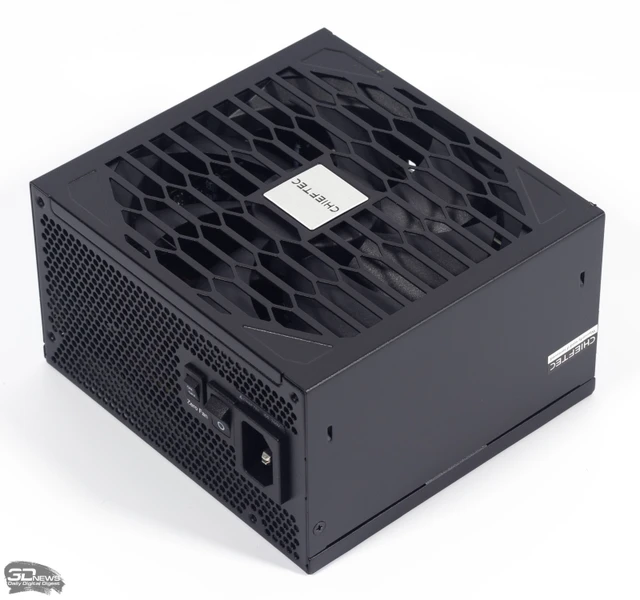
The aesthetic is one of understated minimalism. With a depth of 140mm, the unit integrates seamlessly into the vast majority of modern chassis. Cooling is handled by a 135mm fan, and the inclusion of a physical switch for semi-passive mode allows users to fine-tune their acoustic experience. The cable package is well-balanced: five universal eight-pin connectors and three peripheral/SATA lines cover the needs of most high-performance builds. Notably, the cables feature insulation that mimics fabric braiding for a more premium look, while the conductor gauge (predominantly 18 AWG) remains firmly within industry standards.
A look under the hood reveals an OEM CTC platform from the industry titan Channel Well Technology (CWT). The primary stage employs a classic yet robust protection suite: a two-stage EMI filter, a varistor, and an inrush current limiter based on a thermistor and relay. An interesting design touch is the use of copper plates to shield components soldered to the input connector pins.
The main converter utilizes a half-bridge LLC topology. For a "Platinum" rated device, this choice might seem unexpected, as full-bridge topologies are more common in this class; however, when paired with synchronous rectifiers on the secondary side, this circuit demonstrates impressive efficiency. The bill of materials (BOM) is particularly noteworthy: the use of Japanese electrolytic capacitors from Nippon Chemi-Con and Rubycon ensures long-term stability and durability.
Empirical testing validates the unit's high energy efficiency, with the primary rails reaching 93%, fully justifying the Platinum certification. The power factor (PF) in optimal operating modes nears a near-perfect 0.99. However, the platform's specific characteristics emerge here: when the load is concentrated on the minor rails (3.3V and 5V), efficiency drops noticeably, dipping as low as 66%. In practice, however, these rails are barely utilized in modern PCs, rendering this nuance purely theoretical.
Voltage regulation exhibits varying degrees of precision. The 12V rail performs flawlessly, deviating from the nominal value by no more than 2% across all scenarios. The minor rails are less consistent: the 5V line stays within a 4–5% margin, while the 3.3V rail occasionally drifts outside the permissible ±5% tolerance window. Nevertheless, given the architecture of modern systems—where the bulk of power consumption is driven by the CPU and GPU—this variance is not critical.
One of the unit's most impressive metrics is its voltage ripple. None of the rails exceeded the 36mV threshold, testifying to high-quality output filtering and ensuring the safety of sensitive motherboard and GPU components. Another engineering win is the hold-up time. Under full load, it clocked in at 19.4ms, which not only meets the ATX 3.1 standard but exceeds its baseline requirements, providing an additional safety margin during brief mains voltage drops.
The acoustic profile of the Chieftec Stealth is tuned for maximum comfort. In semi-passive mode, the fan remains stationary until the 12V rail load reaches 200W. Even as power consumption climbs significantly, the rotation speed remains moderate, rarely exceeding 600 RPM across most of the range. The maximum threshold of 1380 RPM is reached only under extreme loads, and since speed control is tied exclusively to output power, the unit avoids abrupt noise spikes caused by component heat-up.
Ultimately, the Chieftec Stealth SPX-1000-FC emerges as a pragmatic powerhouse for high-end home PC builds. While it doesn't strive for absolute perfection in every detail—the stability of the minor rails, for instance, leaves room for improvement—it delivers impeccable performance on the primary 12V rail, excellent noise filtering, and high energy efficiency. The combination of Japanese capacitors, ATX 3.1 support, and competitive pricing makes this PSU one of the most rational choices in its class.
 The Pinnacle of Clarity: AOC's New 5K Monitor