The modern speech synthesis market is undergoing a rapid transition, moving away from static presets toward dynamic, neural-network-driven models. Alibaba’s latest release, Qwen-Audio-3.0-TTS, seeks to resolve the fundamental dichotomy between instantaneous response times and studio-grade audio fidelity. The system's bifurcation into two distinct versions—Flash and Plus—reflects a broader industry demand for specialized tooling tailored specifically for real-time applications versus high-end post-production. However, beneath the surface of the bold marketing claims lie fragmented documentation and regional restrictions—critical hurdles that could complicate professional integration.
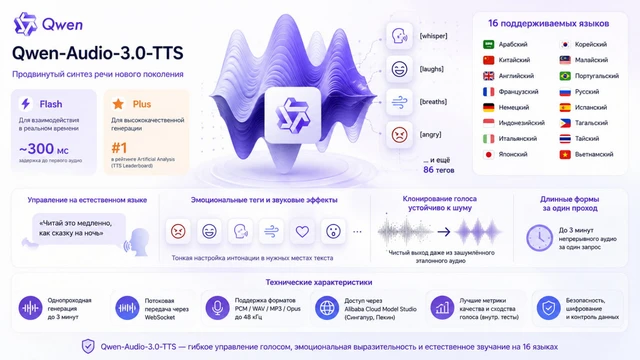
At the core of Alibaba's latest strategic pivot is the bifurcation of a single technological pipeline into two specialized tools. The Flash version is engineered for scenarios demanding ultra-low latency—such as voice assistants and gaming NPCs—where the Time to First Byte (TTFB) hovers around 300ms. It is critical to note that this metric reflects only the server-side response time; the actual perceived pause for the end user will depend on the network stack and the length of the input text. In contrast, the Plus version prioritizes timbral precision and natural prosody, making it the ideal choice for podcasts, audio guides, and complex dialogue synthesis.
This division is driven by a fundamental technical trade-off: a single universal model rarely manages to deliver both near-instantaneous latency and uncompromising quality for extended speech segments. Both versions are available exclusively via the Alibaba Cloud Model Studio infrastructure, supporting WebSocket streaming in the Singapore and Beijing regions. The absence of open weights or a public repository transforms Qwen-Audio-3.0-TTS from a standalone tool into a closed API service, effectively ruling out on-premise deployment.
The matter of language support remains a point of contention. Despite claimed support for 16 languages, including Russian, there is a palpable gap between the model's theoretical capabilities and the available tooling. While technical documentation confirms the system's ability to process Russian speech, the library of preset system voices remains heavily centered on English and Chinese segments. To achieve professional results in Russian, users must rely on voice cloning, utilizing a reference recording ranging from 10 to 60 seconds.
When integrating the system into Russian-language products, developers must account for specific phonetic nuances: the model may struggle with homographs, complex abbreviations, and long numerical sequences. These areas require rigorous testing, as general quality benchmarks do not guarantee flawless stress and intonation in specialized contexts.
Speech delivery is managed through a combination of natural language instructions and inline tags. The model can interpret descriptions of roles, moods, or situations—for instance, prompts like "speak like a radio host" or "sound frightened." This approach is significantly more intuitive than traditional pitch and tempo sliders, though it introduces an element of unpredictability: the interpretation of a "cozy voice" may differ between the model and a sound engineer.
Additional flexibility is provided by 86 built-in tags, such as [laughing], [whispers], or [sighing], allowing emotional accents to be embedded directly into the text. However, there is a noticeable inconsistency in the documentation; tag syntax varies between marketing materials and the current API reference, which can lead to commands being ignored by the system. Furthermore, these tags only function in unidirectional stream mode, complicating the architecture of live dialogues where text is transmitted in small fragments.
Particular attention has been paid to the robustness of voice cloning against acoustic distortion. The system was trained on noisy datasets to effectively suppress reverberation and ambient noise in reference recordings. Nevertheless, the developers emphasize that noise resilience is a safety mechanism rather than a substitute for high-quality source audio. Achieving professional-grade output still requires at least five seconds of clean speech, devoid of background music or overlapping voices. Notably, cloning capabilities in the Plus version are less transparent within the public API compared to the Flash version.
From a technical standpoint, the model is impressive in its ability to synthesize up to three minutes of speech in a single pass. This solves the classic "stitching" problem, where jumps in volume or intonation often occur at the boundaries of fragmented segments. The architecture relies on an audio tokenizer with a frequency of 12.5 frames per second, reducing the number of steps required for autoregressive generation. The training process spanned five stages, moving from separate linguistic and acoustic preparation to final reinforcement learning. The system supports PCM, WAV, MP3, and Opus formats with sampling rates up to 48 kHz, although the availability of the latter may vary by deployment region.
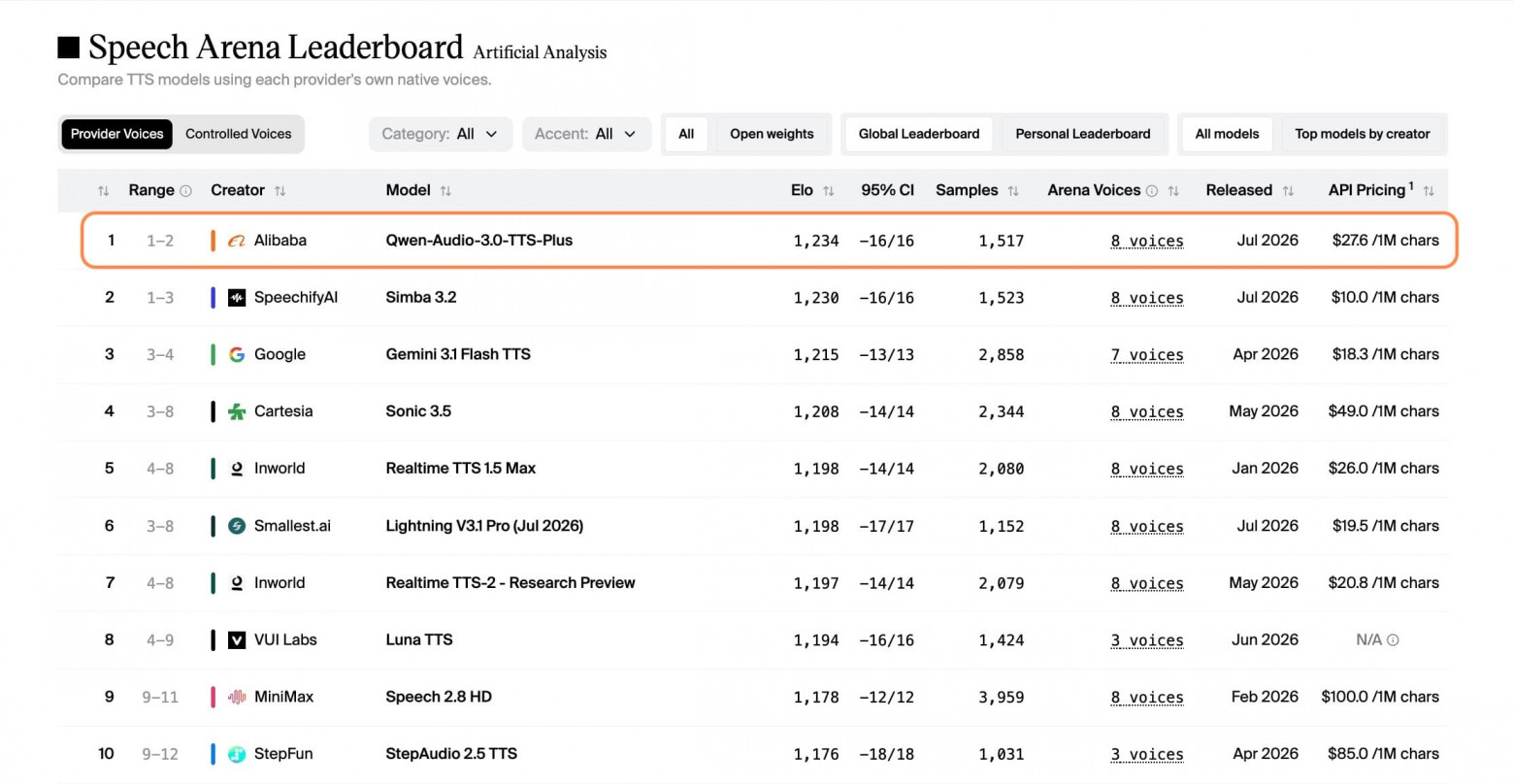
An analysis of independent benchmarks, specifically from Artificial Analysis, shows the Plus version leading the Provider Voice Arena with an Elo of 1234. However, this success should be interpreted with caution: the lead over its closest competitor (Simba 3.2) is marginal and falls within the statistical margin of error. Moreover, these tests were conducted exclusively on English voices. Consequently, global leaderboard leadership does not automatically translate to superior synthesis quality for the Russian language.
The service's economic model is based on per-character pricing. In the international segment, costs are set at $15 per million characters for Flash and $20 for Plus. It is worth noting that discrepancies exist across different data sources regarding pricing; therefore, final budget calculations should be based on current Model Studio billing, accounting for regional coefficients.
Qwen-Audio-3.0-TTS is a powerful tool with an impressive feature set, ranging from low latency to deep emotional control. However, professional implementation requires a critical approach to verifying accent accuracy, tag stability, and the actual cost of resources within the specific region of use.
 The Triumph of 3nm Chip Manufacturing