The contemporary workstation market is undergoing a profound transformation, driven by the exponential growth in demand for local compute power dedicated to AI and high-end rendering. In this relentless pursuit of performance, Nvidia is strategically bridging the gap between entry-level professional solutions and its uncompromising flagship offerings. The introduction of the RTX Pro 5500 Blackwell Workstation Edition serves as a calculated response to a growing segment of users who have outgrown baseline capabilities but do not yet require the extreme overhead of top-tier systems. This GPU is positioned to set a new benchmark for balanced performance within the professional ecosystem.
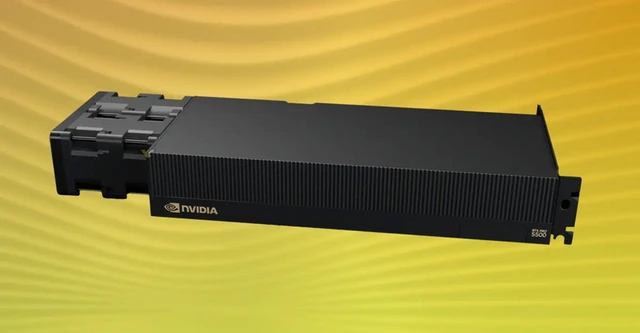
The evolution of professional graphics accelerators is no longer defined solely by raw horsepower, but by the capacity to orchestrate massive datasets. The new RTX Pro 5500 Blackwell Workstation Edition occupies a critical juncture in the company's product hierarchy, positioned precisely between the flagship RTX Pro 6000 and the more modest RTX Pro 5000. By offering significantly expanded memory and a higher power envelope than its junior counterpart, it effectively bridges the gap between a high-end workstation and a dedicated server solution.
The device's technical architecture is formidable: the GPU is equipped with 21,760 CUDA cores, enabling massive parallel processing capabilities for rendering complex visual scenes or training neural networks. Of particular note is the integration of 84 GB of GDDR7 memory with ECC (Error Correction Code) support. In professional environments, error correction is non-negotiable, as a single bit-flip can crash a multi-hour render or compromise the integrity of complex mathematical computations. A 416-bit bus delivers a bandwidth of 1,398 GB/s, minimizing latency during data transfers between the GPU and VRAM.
Regarding its multimedia pipeline, the card features three ninth-generation NVENC encoding blocks and three sixth-generation NVDEC decoding blocks, making it a powerhouse for high-resolution video production and real-time streaming. However, the standout technological feature is support for Multi-Instance GPU (MIG). This functionality allows a single physical card to be partitioned into two isolated virtual instances, each with 42 GB of memory. Such flexibility is critical for multi-user resource sharing or segregating computational workloads to prevent cross-interference.
The device's power envelope places significant demands on infrastructure, with maximum power consumption reaching 600W. To manage this thermal load, two configurations are available: traditional active air cooling and the advanced RXM liquid cooling system. The latter is especially vital for rack-mount deployments, where equipment density necessitates maximum thermal efficiency. The PCIe 5.0 x16 interface and four DisplayPort 2.1b ports ensure the card remains future-proof, supporting the latest standards for data transmission and visual output.
Comparative analysis reveals that the RTX Pro 5500 closely mirrors the capabilities of the flagship RTX Pro 6000. The disparity in CUDA core count is a mere 9.6%, with memory capacity trailing by only 12.5%. While the flagship boasts higher memory bandwidth (1,792 GB/s versus 1,398 GB/s), this difference will be virtually imperceptible for most practical applications. Conversely, the gap between this model and the entry-level RTX Pro 5000 is stark: the latter is capped at 300W and offers memory ranging from 48 to 72 GB.
The product is currently in the final stages of its global rollout across markets including the US, UK, India, and Japan. While precise pricing remains undisclosed and technical specifications are listed as preliminary, it is evident that Nvidia is crafting a tool for those operating at the intersection of high-performance design and full-scale data center computing.
 Anthropic’s Strategic Financial Surge Ahead of Its IPO