The efficacy of maritime search-and-rescue operations has traditionally been constrained by human response times and physical limitations. In critical scenarios—such as extreme hypothermia or loss of consciousness—passive flotation devices are simply insufficient; the situation demands active extraction from the water. To overcome this engineering challenge, development is shifting toward intelligent autonomous platforms capable of independent target acquisition and transport. Project QuadBoat represents an ambitious synthesis of biomimetic principles and advanced control algorithms, aiming to engineer a truly universal rescue vehicle.
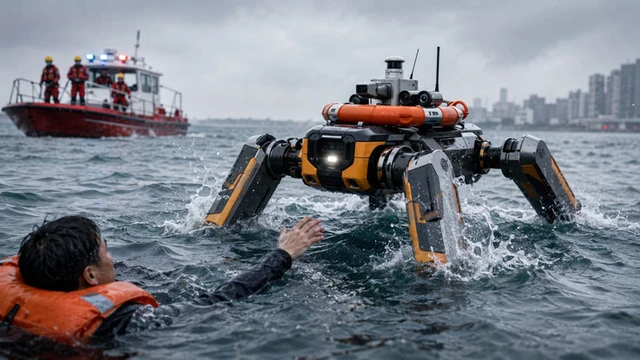
The QuadBoat concept is rooted in biomimicry, specifically the behavioral mechanisms of silver spiders. These creatures possess a unique ability to traverse water surfaces and efficiently capture prey—a capability that served as the catalyst for researchers from the Shenzhen Institute of Artificial Intelligence and Robotics (AIRS), the Chinese University of Hong Kong, and the Stevens Institute of Technology. Moving away from traditional hull designs, the engineers developed a "quadrimaran": a platform supported by four adaptive floats that function as multifunctional limbs.
Each limb features four degrees of freedom, enabling the system to dynamically alter its geometry. By adjusting its width (ranging from 1.188 to 1.85 meters) and lift height (from 0.425 to 0.643 meters), the QuadBoat can adapt to challenging environments, navigating narrow apertures or overcoming low-lying obstacles. Screw propulsion systems mounted at the end of each float provide maneuverability and speeds up to 0.8 m/s. With a prototype weight of 25 kg, it supports a payload of 20 kg, while a 58,800 mAh lithium-ion battery provides up to two hours of operational autonomy.
The device's technical stack utilizes a hierarchical architecture, decoupling high-level planning from low-level execution. A Model Predictive Controller (MPC), powered by an onboard Raspberry Pi 4B with an ARM Cortex-A72 processor, manages overall trajectory and hull motion forecasting. Simultaneously, Arduino Nano microcontrollers handle the direct control of actuators, propellers, and joints, ensuring near-instantaneous response times. For target acquisition, an integrated camera works in tandem with a shore-based computer via a wireless network to determine the coordinates of the casualty.
Field trials conducted in both controlled pool environments and open water demonstrated the system's significant potential while highlighting several critical bottlenecks. In terms of positioning, the robot exhibited impressive precision, with an error margin of only 16–18 mm. However, the actual efficacy of mannequin rescue fell short of expectations: while the success rate reached 70% in the pool, it dropped to 50% in open water. The average task completion time ranged between 116 and 132 seconds.
At its current stage, QuadBoat remains a promising proof-of-concept requiring substantial refinement. The primary constraint is payload capacity; 20 kilograms is insufficient for the evacuation of an adult human. Furthermore, the guidance system remains susceptible to external variables—wind loads, surface turbulence, and solar glare—which interfere with the optical sensors. Nevertheless, the project charts a clear course for the development of autonomous emergency response systems, where structural adaptability becomes a critical factor for survival.
 The Expansion of the 1c Process Node in DRAM