Urban air mobility is evolving from a utopian vision into a high-stakes engineering race centered on certification and safety. At the heart of this conflict lie two divergent philosophies: sophisticated winged hybrids and radically streamlined multicopters. Japan's SkyDrive SD-05 project is betting on minimalism, aiming to validate the viability of wingless systems within the constraints of dense urban environments. Recent successful flight tests reaching speeds of 100 km/h have served as a critical validation of the project's computational models. The project is now entering the final phase of preparation for its commercial debut.
Achieving a stable cruise speed of 100 km/h for the SkyDrive SD-05 is more than a mere metric in a technical report; it is a fundamental validation of the chosen engineering trajectory. In the eVTOL (electric Vertical Take-Off and Landing) industry, speed often takes a backseat to predictability and stability. For the Japanese developers, backed by the resources of Toyota, the primary outcome of these tests was the validation of aerodynamic loads. The fact that vibrations and structural stresses at cruise speed aligned precisely with computer simulations clears the path toward certification by the Japan Civil Aviation Bureau (JCAB). In aerospace engineering, such a correlation between theory and practice is the only legitimate basis for discussing an aircraft's operational clearance.
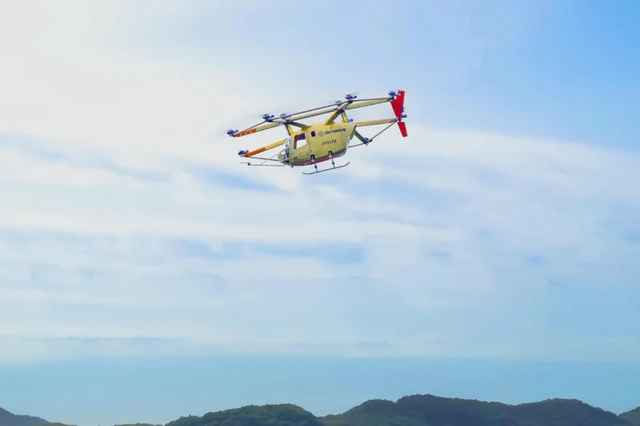
The technical architecture of the SD-05 represents a conscious departure from complexity. While American giants such as Joby Aviation and Archer are pursuing "transition" aircraft featuring fixed wings and tilt-rotors, SkyDrive has opted for radical simplification. The SD-05 eschews wings and the complex mechanical hinges that typically serve as the most vulnerable points in traditional designs. Instead, flight control is managed via a system of 12 independent rotors, fully orchestrated by an onboard computer.
This approach provides an undeniable advantage within the constraints of a megacity. The absence of a wide wingspan allows for significantly more compact takeoff and landing pads, a critical factor for integration into existing urban infrastructure. Furthermore, minimizing moving mechanical parts substantially reduces both the cost and frequency of maintenance, evolving the electric aircraft from a costly aviation asset into a more accessible transport module.
Yet, beneath this structural simplicity lie significant challenges in energy efficiency. The current prototype, designed to carry a pilot and two passengers, possesses a modest range of approximately 15 kilometers. While sufficient for short urban hops, developers aim to extend this to 30–40 kilometers to provide comprehensive coverage of a metropolitan area. Achieving this will require either aggressive weight optimization or the implementation of higher-density battery cells—the primary "pain point" currently plaguing the entire electric aviation industry.
On the global stage, the SD-05's closest ideological relative is China's EHang EH216-S. This two-seater autonomous drone has already secured certification from its local regulator, though its application remains limited to low-altitude sightseeing flights. SkyDrive intends to leapfrog this stage, developing a fully realized transport tool with superior speed and altitude performance.
The project's roadmap involves a gradual expansion of the "flight envelope"—testing in more adverse weather conditions and at varying altitudes to gather the data necessary for final regulatory approval. If the current momentum holds, the SkyDrive SD-05 could evolve from an ambitious prototype into a tangible component of the urban transport ecosystem by 2028, offering a viable alternative to the congested arteries of Tokyo and other global capitals.
 The Evolution of Solid-State Batteries: From Smartphones to Electric Vehicles