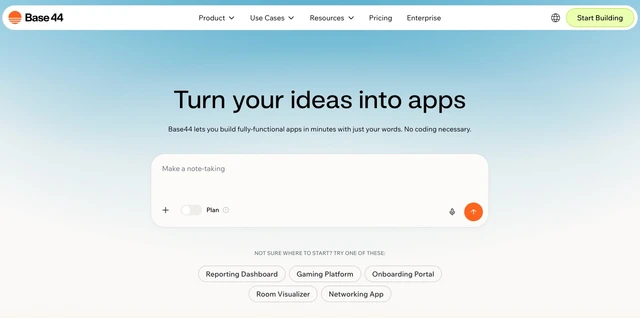
Modern software engineering is undergoing a fundamental paradigm shift: manual coding is giving way to "vibe-coding," an approach where user intent and interface design take center stage. Yet, beneath this veneer of simplicity lies a precarious dependency—platforms remain tethered to the AI behemoths that control the foundation models. The emergence of Base1 from the startup Base44 marks a strategic attempt to break this cycle and pursue technological sovereignty. This move underscores a pivotal industry trend: competition is shifting away from the surface level of user interfaces toward the deeper complexities of weight optimization and the training of specialized neural networks.
The phenomenon of "vibe-coding" has transformed application development into a conversational dance with the system, where the developer sets the general direction and "mood" of the product while the AI handles the grunt work of implementation. For a long time, such platforms operated as sophisticated wrappers around powerful general-purpose models like Anthropic’s Claude Opus. However, this strategy carries a systemic risk: any shift in pricing or API terms from the provider can instantly collapse a business's unit economics. This vulnerability is precisely what drove Base44—the company acquired by Wix for $80 million a year ago—to develop its own proprietary solution, Base1.
Base1’s stated ambition is to outperform the leading frontier models in application assembly. Yet, upon closer inspection, it becomes clear that this is not about building a new neural network from scratch. Training a full-scale foundation model requires billions in investment and colossal computational power available only to a handful of players. Instead, Base44 has opted for deep fine-tuning of an open-source base.
The technological stack of Base1 leverages the platform's own proprietary data: tens of millions of user sessions have served as the fuel for its training. By employing reinforcement learning (RL) and runs in simulated environments, they have honed the model for a specific objective—translating abstract prompts into functional code. Despite a lack of public benchmarks, Base44’s strategy demonstrates a pragmatic approach to creating a narrow-domain tool designed to be more efficient than a generalist giant within its own niche.
Cursor previously followed a similar trajectory. Its Composer 2.5 model was built upon Moonshot's Chinese Kimi K2.5, achieving performance levels close to Opus while slashing operational costs tenfold. For Cursor, however, this was merely an intermediate step. Having gained access to Elon Musk’s Colossus 2 supercomputer, the startup has moved toward creating its own model with 1.5 trillion parameters, underscoring the industry's growing appetite for raw compute.
The economic logic driving Base44 is simple: ownership of the model means direct control over infrastructure costs and expanded profit margins. For the parent company, Wix—which is currently undergoing a painful workforce optimization—such efficiency is critical. Meanwhile, Base44 itself is experiencing explosive growth; the project's annual revenue surged from $3 million to $150 million in less than a year, though it still trails market leaders like Lovable.
The central paradox of this situation is that the quest for independence is happening simultaneously with the expansion of AI labs into the vibe-coding territory. The release of Claude Code by Anthropic turns the model provider into a direct competitor. Now, the giants possess both the powerful models and the telemetry on how humans actually assemble applications.
In this struggle, Base44 is betting on narrow specialization. The hypothesis is that deep expertise in a specific domain will provide an edge over general-purpose systems. Ultimately, the industry is moving toward a reality where any significant player with sufficient data will be forced to train their own models. Vibe-coding has ceased to be a competition over who has the most intuitive code editor; it is now a race "under the hood," where the winner will be whoever builds the most efficient and cost-effective intelligence for generating a working product.
 Anthropic’s Strategic Push for Hardware Independence