The boundary between Windows and Linux has become virtually seamless in recent years, transforming the developer’s workstation into a versatile sandbox. Microsoft is taking another strategic leap forward by embedding native containerization support directly within the WSL subsystem. Consequently, the pursuit of environment isolation and streamlined deployment no longer hinges on cumbersome third-party abstractions. This initiative effectively redefines Windows as a high-performance orchestration layer for the Linux toolchain.
For a long time, the conventional approach to running containers on Windows was installing Docker Desktop. While functional, it introduced an unnecessary layer of abstraction and consumed significant system resources. The WSL Containers (WSLC) technology, unveiled at Build 2026, is designed to eliminate this dependency, allowing developers to interact with Linux containers directly through native operating system mechanisms. Access to these features is provided via WSL preview builds, which can be activated through a simple update command or specialized releases on GitHub.
The cornerstone of this management system is the new wslc.exe command-line interface. It is engineered to be intuitive for those accustomed to traditional container workflows, ensuring a seamless transition from environment configuration to application deployment. However, the true value of this update lies not in the CLI, but in its deep integration at the API level.
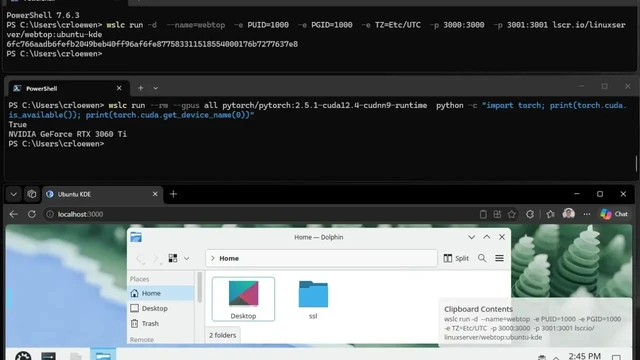
WSLC’s capabilities extend far beyond merely launching server-side applications. The system enables the deployment of full graphical environments, such as Ubuntu KDE, with robust port forwarding. Particular emphasis has been placed on Machine Learning and Data Science: via the --gpus all flag, GPU hardware is mapped directly to the environment. This is critical for frameworks like PyTorch, where direct access to GPU compute cores is the primary driver of model training efficiency.
For enterprise-grade development, Microsoft has integrated the API directly into MSBuild and CMake. This transforms container management from a manual process into part of a declarative project specification. Environment preparation and dependency orchestration can now be hard-coded into build configuration files, effectively mitigating the perennial "it works on my machine" syndrome.
The WSLC technology stack also introduces critical optimizations for I/O and networking. The implementation of the virtiofs file system is designed to radically accelerate data exchange between the Windows host and the Linux guest environment, eliminating one of virtualization's primary bottlenecks. Simultaneously, an experimental networking mode called "consomme" has been introduced. It addresses long-standing compatibility issues with corporate VPN clients by routing Linux traffic directly through the Windows network stack, thereby eliminating routing conflicts within secure corporate networks.
From a security and isolation perspective, WSLC departs from the concept of running within a shared WSL distribution. Instead, each application or shell session triggers the launch of its own lightweight Hyper-V virtual machine in the background. This approach ensures strict segmentation of data and processes; applications remain isolated from one another, significantly reducing the risk of lateral data access and enhancing overall system resilience.
 The Price of Acceleration: CXMT’s Rapid Push into Memory