The boundary between digital cognition and physical agility is blurring at an accelerating pace. Nvidia’s ENPIRE project showcases the ability of contemporary AI agents to autonomously master intricate real-world manipulations, moving beyond the limitations of rigid, hard-coded programming. By synthesizing the power of Large Language Models (LLMs) with robotic hardware, the system shifts toward a paradigm of experiential learning and iterative error analysis. This evolution clears the path for truly agile, autonomous production environments capable of adapting to new operational demands in real time.
For too long, modern robotics has been plagued by the problem of "rigid scripting": a machine could execute a single operation a million times with flawless precision, yet become utterly useless the moment environmental conditions shifted. Project ENPIRE proposes a fundamental paradigm shift, reimagining robots as autonomous learners. Rather than adhering to hard-coded instructions, a fleet of machines driven by intelligent agents independently explores physical space, mastering high-precision tasks that demand intricate fine motor skills and dexterity.
At the core of the system lies a synergy between raw computational power and the cognitive capabilities of Large Language Models (LLMs). The project deployed eight AI agents based on OpenAI Codex, each allocated specific GPU resources and token quotas. Their objective was clear: to master specific physical actions as rapidly and accurately as possible.
The learning process mimics human problem-solving; the agents do not simply iterate through random permutations but employ a comprehensive analytical loop. They scan the environment for visual cues, consult technical documentation online, debate strategies among themselves, and conduct a series of live iterations on the hardware. If an action fails, the system resets the scene and modifies the control functions, effectively performing real-time self-correction.
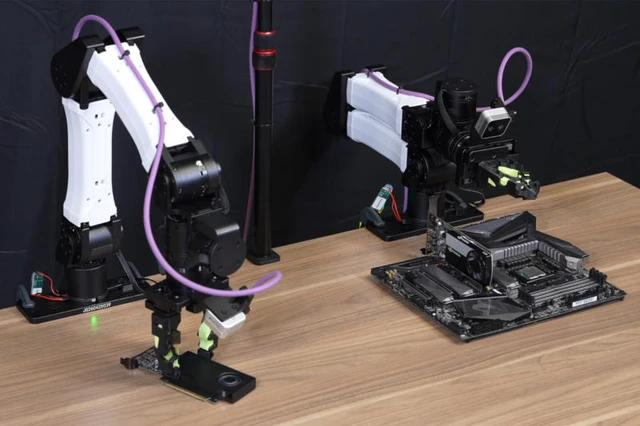
Practical validation of the system involved several precision-critical electronic assembly tasks: sorting metal pins, installing and trimming plastic cable ties, and the final assembly of PC components. In one of the most compelling demonstrations, two robotic arms worked in tandem: one manipulator gripped a graphics card and handed it off to the second, which carefully seated the device into the motherboard's PCIe slot. Despite perceptible instability and slight oscillations of the structure during installation, the task was completed successfully.
A notable technical detail was the choice of components. The tests utilized compact GPUs, while bulky flagship solutions—such as the RTX 5090 series—were excluded. This suggests that current systems still struggle with objects possessing significant mass and leverage, highlighting a need for more sophisticated pressure control and balancing algorithms.
To conduct a deep dive into efficiency, researchers benchmarked various neural engines, including OpenAI Codex agents powered by GPT-5.5, Claude Code with Opus 4.7, and Kimi Code with Kimi K2.6. The comparative analysis revealed that the primary driver of learning speed is not merely the power of an individual model, but the scale of parallel exploration. A group of eight robots experimenting simultaneously with different approaches to a single task reaches a solution significantly faster than a lone agent or a small cluster. This confirms the hypothesis that collective experience and distributed learning represent the shortest path toward achieving industrial-grade autonomy.
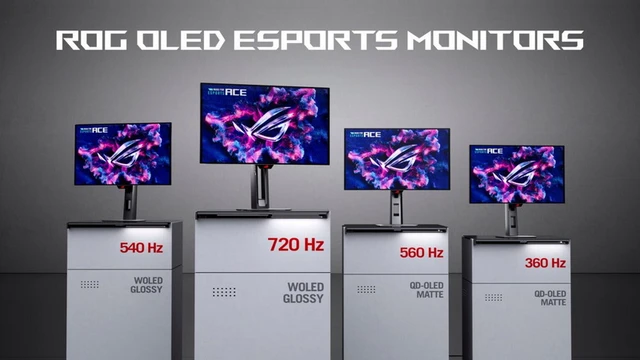 The Speed Limits of Modern Gaming Displays