The "last mile" remains the most expensive and labor-intensive bottleneck in the entire logistics chain. Urban environments, with their erratic topography, often prove insurmountable for traditional wheeled automation systems. Boston Dynamics proposes a fundamental reimagining of this workflow by synthesizing human intelligence with the exceptional mobility of quadrupedal robots. This shift evolves the role of the courier from a simple transporter into the operator of a high-tech autonomous fleet.
The challenge of last-mile delivery has long been hindered by infrastructural constraints. While wheeled robots—once viewed as the primary vector for autonomous logistics—demonstrate high efficiency in flat warehouses or pristine sidewalks, they often falter when faced with the realities of a typical urban landscape. Stairs, high curbs, and uneven garden paths transform their routes into a series of insurmountable obstacles.
In this context, the deployment of Spot, the quadruped robot, unlocks entirely new possibilities. Leveraging sophisticated kinematics and advanced stabilization systems, the machine can navigate spaces previously accessible only to humans. This enables the automation of deliveries in suburban areas and residential complexes with irregular terrain where traditional robotics simply cannot operate.
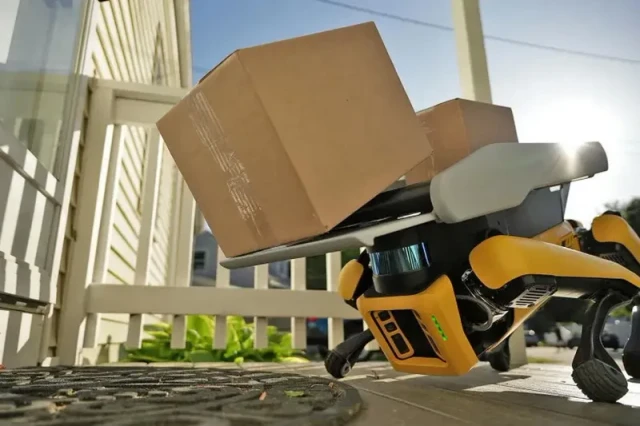
The technical implementation of this concept involves mounting a specialized conveyor platform on Spot's back. The workflow is streamlined: from the van, the courier loads parcels onto the robot's belt, after which the machine autonomously navigates to the destination. Upon arrival, Spot offloads the shipments directly at the customer's door before returning to the vehicle for the next batch of cargo.
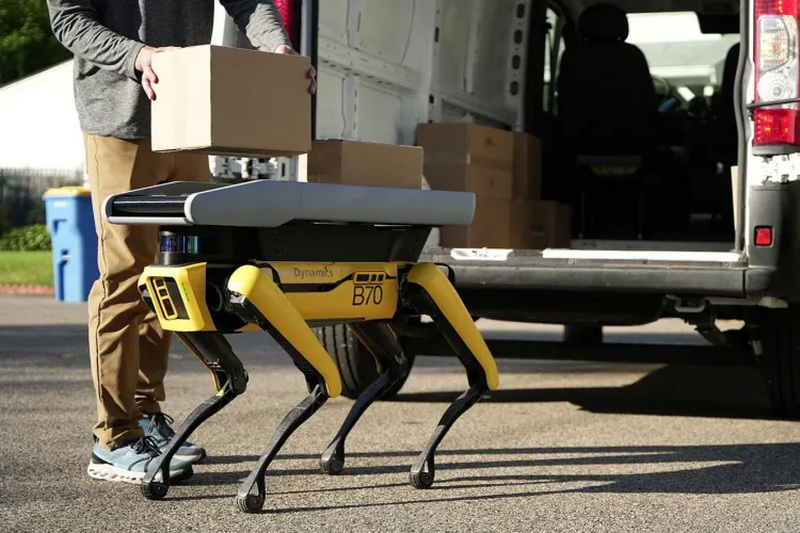
It is crucial to recognize that this strategy does not imply the total displacement of human labor. Rather, it is about creating a synergy where the robot handles the most arduous and repetitive physical demands—transporting cargo across rugged terrain. While Spot completes the trek to the doorstep, the courier can focus on route optimization and preparing subsequent shipments. This parallelization of workflows significantly boosts delivery throughput, allowing for a higher volume of orders per unit of time without increasing the burden on personnel.
Currently, the project is in the demonstration phase. Boston Dynamics has moved into negotiations with major logistics players to transition these conceptual showcases into full-scale pilot deployments. The shift from laboratory testing to real-world operation will mark a pivotal step in the evolution of urban environments, where autonomous systems become a seamless extension of human labor.
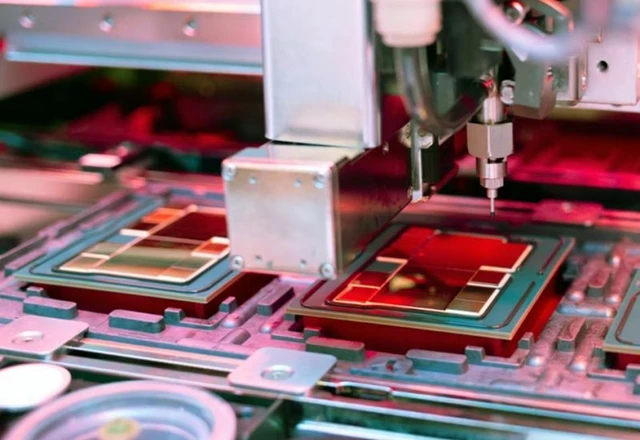 Intel’s Strategic Play for Advanced Packaging Supremacy