In the quest for habitable worlds, astronomers frequently overlook the cosmos's most extreme fringes—regions where planetary geology borders on total catastrophe. The super-Earth 55 Cancri e embodies one such extreme scenario, serving as a natural laboratory for probing the evolutionary trajectories of rocky planets. Recent data from the James Webb Space Telescope has compelled scientists to rethink long-standing models regarding atmospheric formation on such celestial bodies. Researchers now have a rare opportunity to peer directly into the chemical heart of an alien world.
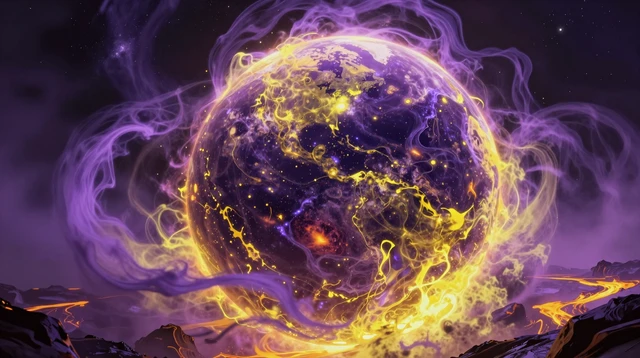
Situated 41 light-years away, the exoplanet 55 Cancri e challenges our conventional understanding of planetary equilibrium. This massive rocky world boasts a radius nearly twice that of Earth and a mass eight times greater. However, its most striking characteristic is its extreme proximity to its host star: a full orbit takes a mere 0.7 days—a stark contrast to Mercury's 88-day journey. Such an aggressive orbit transforms the super-Earth's surface into a literal hellscape, where temperatures are sufficiently high to keep rock in a molten state.
Leveraging data from five secondary eclipses—the moments when the planet vanishes behind its star's disk—a research team conducted a detailed spectral analysis of 55 Cancri e’s atmosphere. Until now, theoretical models of rocky exoplanet evolution predicted a dominance of carbon monoxide (CO) and carbon dioxide (CO₂). The reality, however, proved more complex: the James Webb Space Telescope detected an abundance of carbon monoxide alongside unexpectedly low levels of carbon dioxide and, most surprisingly, a significant concentration of hydrogen.
This chemical imbalance is fundamental to understanding the planet's internal architecture. In astrophysics, the composition of a secondary atmosphere is directly linked to the redox state of the interior. The prevalence of hydrogen over oxygen indicates low oxygen fugacity within the mantle. This suggests that gases are outgassing from a so-called "reduced" magma ocean, which serves as the primary source of atmospheric material. Consequently, the planet's gaseous envelope becomes a transparent window, allowing scientists to analyze the chemistry of deep interiors that remain otherwise inaccessible to direct observation.
Particular interest lies in the fluctuations observed within the data. Researchers believe the atmosphere of 55 Cancri e is far from static; it is shaped by powerful volcanic outgassing. Bursts of activity may trigger the formation of dense clouds composed of mineral vapors, which temporarily shield and cool the surface before new gas flows disperse the layer.
The phenomenon of "lava planets" has become a focal point of modern astronomy over the last decade. 55 Cancri e is just one of many extreme worlds, such as K2-141 b or CoRoT-7 b, which exist in a state of tidal locking. This means one hemisphere is eternally exposed to its star—a blazing ocean of magma—while the other remains shrouded in perpetual darkness. In some instances, such as L 98-59 d, the magma ocean may encompass the entire surface, creating a landscape reminiscent of Jupiter's moon Io, but on a planetary scale.
The discovery of a hydrogen-rich atmosphere on 55 Cancri e confirms that the evolution of super-Earths follows far more diverse trajectories than previously assumed. This raises new scientific questions regarding how volatiles are distributed in early stellar systems and what specific conditions allow a rocky planet to retain its atmosphere under the onslaught of intense stellar radiation.
 A Pragmatic Approach to Lunar Equipment Design