The mobile workstation industry is undergoing a fundamental paradigm shift toward Arm-based platforms, driven by the pursuit of a synergy between extreme energy efficiency and uncompromising power. The introduction of Nvidia RTX Spark signals a departure from traditional resource partitioning, pivoting instead toward the concept of a unified compute fabric. The Asus ProArt P14 emerges as one of the first tangible manifestations of this vision, packing professional-grade tooling into a remarkably compact chassis. In essence, this machine migrates data-center-class capabilities directly onto the creative professional's desktop.
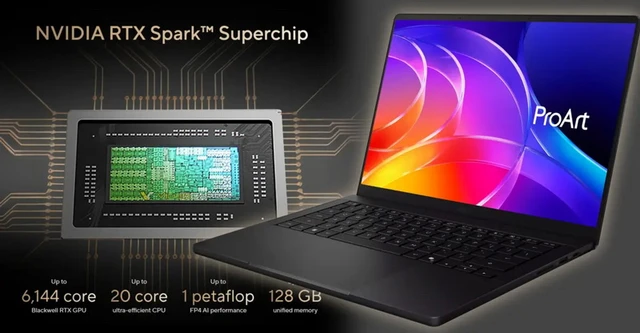
The debut of the ProArt P14 represents a watershed moment in the evolution of mobile computing. At the heart of the device lies the RTX Spark superchip—an ambitious Nvidia project that fuses a 20-core Arm-based Grace CPU with a Blackwell GPU boasting 6,144 CUDA cores. This level of integration allows for a radical reimagining of data processing by effectively eliminating the traditional bottlenecks associated with communication between the central and graphics processors.
The cornerstone of its technical edge is the implementation of unified LPDDR5X memory. Departing from traditional architectures where system RAM and VRAM are siloed, this system utilizes a single pool of resources. While configurations range from 24 to 64 GB, the top-tier version can support up to 128 GB. This unlocks unprecedented capabilities for handling massive neural networks and intricate 3D environments—tasks that previously demanded the raw power of a dedicated workstation.
The platform's computational prowess is most evident in AI workloads. With performance reaching 1 PFLOPS in FP4 precision, the ProArt P14 emerges as a formidable tool for the local deployment and fine-tuning of Large Language Models (LLMs). Yet, it retains its versatility; integrated support for DLSS, Reflex, and G-Sync ensures it doubles as a high-performance gaming rig.
The visual experience is driven by a 14-inch touch OLED panel with a resolution of 2880 × 1800 pixels. A 120Hz refresh rate ensures fluid interface navigation, while peak luminance options of 1100 and 1600 nits in HDR mode guarantee color fidelity and visibility even under intense ambient lighting.
The primary engineering feat was condensing this level of power into a chassis weighing just 1.48 kg with a thickness of 15.9 mm. To sustain this performance, the device is equipped with a 90Wh battery and supports charging via the modern 140W USB-C standard. Data storage is handled by high-speed PCIe 4.0 NVMe drives with capacities up to 1 TB.
The I/O array is meticulously tailored for the needs of content creators. The device features three USB 4.0 Gen3 Type-C ports with throughput up to 40 Gbps, an HDMI 2.1 FRL port, and a full-sized SD 4.0 card reader—a critical inclusion for the rapid offloading of footage from professional cameras. Rounding out the hardware stack are the latest connectivity standards: Wi-Fi 7 and Bluetooth 5.4.
Market appetite for the RTX Spark platform has been unexpectedly voracious; reports indicate that the initial batch of laptops was fully reserved by partners before official sales even commenced. The ProArt P14, alongside its larger sibling, the P16, is poised to lead the first wave of Nvidia-powered Arm devices hitting the market this autumn.
 The Strategic Alliance of Nvidia and MediaTek