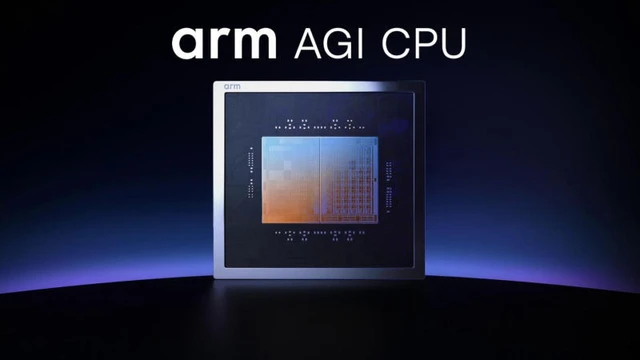
Modern data centers are undergoing a fundamental transformation, pivoting from traditional computing toward the era of generative AI. In this high-stakes race, legacy x86 architectures are increasingly hitting a wall, constrained by power efficiency bottlenecks and memory bandwidth limitations. Arm is countering this trend with the AGI processor—an ambitious challenge to the long-standing hegemony of Xeon and Epyc. This silicon is designed to redefine the very architecture of server systems, delivering unprecedented core density and radically optimized data throughput.
The unveiling of Arm AGI at the Hot Chips 2026 conference signals a pivotal shift in the ongoing architectural battle for server dominance. Designed as a dual-chiplet solution, the processor is capable of scaling up to 136 Neoverse V3 cores. With clock speeds ranging from 2.8 to 3.7 GHz and a massive 272 MB system cache, AGI is engineered specifically for the most resource-intensive workloads in the modern cloud segment. Notably, while each physical chiplet contains 70 cores, a portion of these are designated as redundancies to ensure high silicon yields during manufacturing.
The defining departure from the strategies employed by AMD, Intel, or Nvidia lies in its topology. While competitors frequently offload I/O controllers to a dedicated specialized die (I/O die), Arm has opted for a decentralized approach. Each AGI chiplet functions as an autonomous unit, integrating compute cores, memory controllers, and I/O interfaces. This architecture minimizes memory access latency, driving it down to record-breaking levels of under 10 ns, as data no longer needs to traverse the distance to a neighboring die.
The two chiplets are bridged via the UCIe standard, operating at 32 GT/s to provide an aggregate throughput of approximately 2 TB/s. Internally, each die utilizes the CMN-S3 interconnect fabric with an 8×9 topology. This network does more than just link cores and accelerators; it maintains strict memory coherence, effectively merging two physical dies into a single, seamless NUMA (Non-Uniform Memory Access) system.
Engineers have placed a strategic emphasis on the memory subsystem, recognizing that modern AI agents demand colossal bandwidth. AGI supports DDR5-8800, delivering a total bandwidth of up to 844.8 GB/s and allowing for up to 6 TB of memory per socket. To manage this massive data flow, Arm has implemented MPAM (Memory Partitioning and Monitoring) technology. This allows for the rigid segregation of memory resources between different components, preventing a single process from saturating the channel and creating bottlenecks for other operations.
The technological stack is further bolstered by advanced RAS (Reliability, Availability, and Serviceability) mechanisms. The processor is capable of correcting individual DRAM chip failures and protecting the system against RowHammer-style attacks—capabilities that are critical for the stability of large-scale enterprise environments.
Regarding connectivity, Arm AGI offers a cutting-edge arsenal: 96 PCI Express 6.0 lanes with CXL 3.0 support. The latter standard enables memory expansion and the creation of shared resource pools across servers, effectively blurring the line between local storage and network-attached resources. Meanwhile, the processor's thermal design power (TDP) is maintained at 300W, making it highly competitive from an energy-efficiency standpoint.
Although independent public benchmarks are not yet available, Arm claims a twofold increase in performance per server rack compared to current x86 systems. Should these projections hold true, the server computing market may be facing its most significant disruption in decades. Commercial shipments of AGI are expected in the coming months.
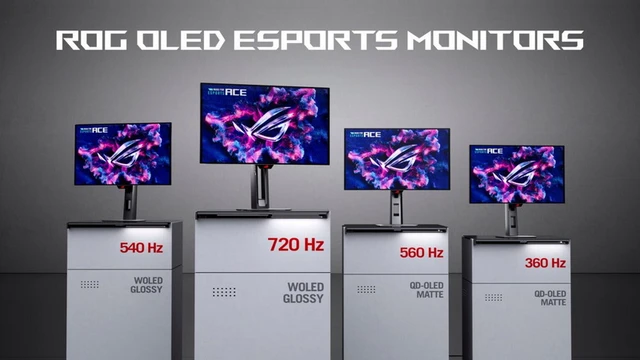 The Speed Limits of Modern Gaming Displays