For years, the foldable smartphone market has served as a proving ground for Samsung and China's tech titans. However, the entry of a new dominant force is poised to fundamentally shift consumer behavior paradigms across the industry. Analysts anticipate that Apple’s foray into this category will transcend a mere product launch, acting instead as a potent catalyst for global demand. The arrival of a foldable iPhone is expected to redefine the benchmarks of the premium segment and accelerate the mass migration toward large-format displays.
The debut of Apple’s first foldable smartphone, anticipated by 2026, is poised to trigger a tectonic shift in the global mobile landscape. According to forecasts from Counterpoint Research, the tech giant could instantly capture a quarter of all shipments in this segment, providing a massive catalyst for the growth of the flexible display category as a whole.
The current market hierarchy is set for a significant realignment. While Samsung is expected to maintain its lead with a 32% share, its dominance will noticeably erode compared to previous peaks of 40%. Experts predict Apple will immediately secure the second position with a 25% share, effectively displacing Huawei, whose market presence may contract from 30% to 24%. Other players, such as Motorola and Honor, will remain confined to narrow niches, while the combined share of all other manufacturers will hover around 8%.
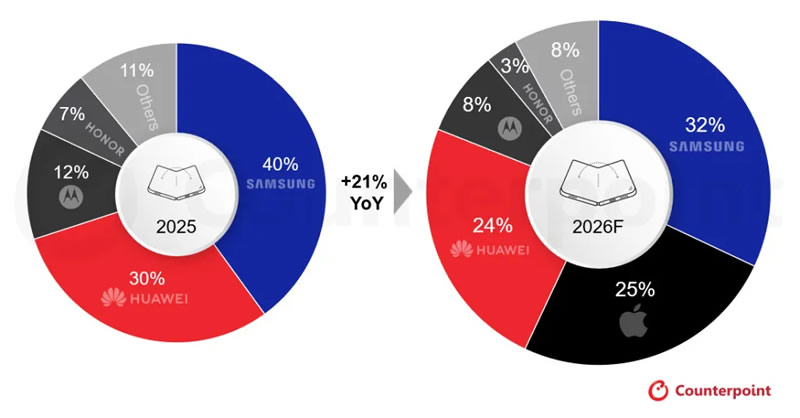
Total global shipments of foldable devices are projected to rise by 21% by 2026. This surge is driven not only by the "Apple effect" but also by a profound technological transformation within the smartphones themselves. The primary catalyst is the integration of advanced artificial intelligence. To fully leverage Large Language Models (LLMs), handle complex content editing, and manage sophisticated multitasking schedules, screen real estate is required that simply cannot be provided by the traditional "slab" form factor. Foldables are emerging as the ideal vehicle for unlocking AI's potential, evolving the smartphone into a comprehensive mobile workstation.
Simultaneously, we are witnessing a compelling convergence in design. The latest iterations of Samsung’s Galaxy Z Fold series demonstrate a trend toward shorter, wider chassis, enhancing ergonomics and bringing the device's proportions closer to those of a tablet. These structural shifts mirror leaks surrounding the future "iPhone Ultra." Despite Samsung leadership dismissing these similarities as coincidental, the industry is gravitating toward a unified "golden ratio" for foldables—where the equilibrium between folded compactness and unfolded utility becomes the ultimate determinant of success.

 The Triumph of 3nm Chip Manufacturing