The global AI arms race has shifted its center of gravity from algorithmic refinement to the raw capabilities of physical hardware. Apple, long a proponent of edge computing and local processing, is now pivoting toward a massive cloud ecosystem: Private Cloud Compute. This strategic move aims to synthesize uncompromising data privacy with the colossal processing power of remote servers. Recent technical leaks offer a rare glimpse into the inner workings of this closed system, which is poised to serve as the bedrock for the company's next generation of intelligent services.
Apple's ambition to dominate the generative AI landscape has culminated in the creation of Private Cloud Compute—a specialized infrastructure where data security is treated as an absolute. Unlike the traditional cloud giants, Apple is engineering its servers from the ground up, integrating proprietary silicon with custom-designed cooling systems. The production of these units is concentrated at a facility in Houston, Texas, underscoring the strategic criticality of the project for the corporation.
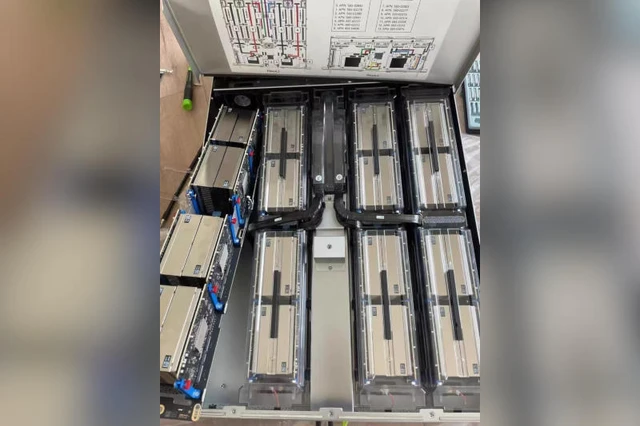
From a technical standpoint, the system is housed in a standard 2U rack-mount chassis. The engineering philosophy is rooted in deep modularity: the device consists of four independent blocks. Within each block are eight boards hosting the computing modules. This layout maximizes component density by positioning the boards on the outer edges of the blocks, leaving the central void open for heat dissipation systems.
At the heart of the system lie the M5 family processors. Based on available data, Apple is utilizing the top-tier variant—the M5 Ultra. Leveraging in-house silicon in the server segment provides Apple with a unique competitive edge: the ability to create a unified memory and compute fabric that operates in lockstep with client devices. This synergy minimizes latency when transmitting requests from an iPhone or Mac to the cloud node.
Of particular interest is the orchestration of these resources. The system employs a decoupled architecture: the server itself is dedicated exclusively to computation, while software management and task orchestration are delegated to an external device—a Mac Studio. This design allows the control node to be placed within a separate secure perimeter, enhancing the system's overall fault tolerance and security. A master control board runs along the entire server block, linking the peripheral modules via a system of specialized cabling.
Thermal management is a critical pillar of the server's design. Apple's engineers have optimized the system to ensure maximum laminar airflow. The heat sinks, positioned at the center of each block, feature optimized fin geometry to allow for unobstructed air circulation. Transparent protective shrouds on the side and bottom panels serve not only as shields but also as air guides, forcing the airflow from the front of the server to the rear to prevent the M5 Ultra chips from overheating under peak loads.
 The Economic Paradox of the GeForce RTX 5090