In an era of hyper-engineered smartphones and the relentless barrage of instant notifications, the industry is witnessing an unexpected pivot toward "conscious simplification." Today's users are increasingly prioritizing the raw authenticity of a moment over pixel-perfect precision—a tactile experience once synonymous with analog film. Camp Snap addresses this longing by reimagining the legacy of the 1970s compact camera. The new 110D model serves as a bridge, spanning the gap between Kodak-era nostalgia and the demands of the digital age.
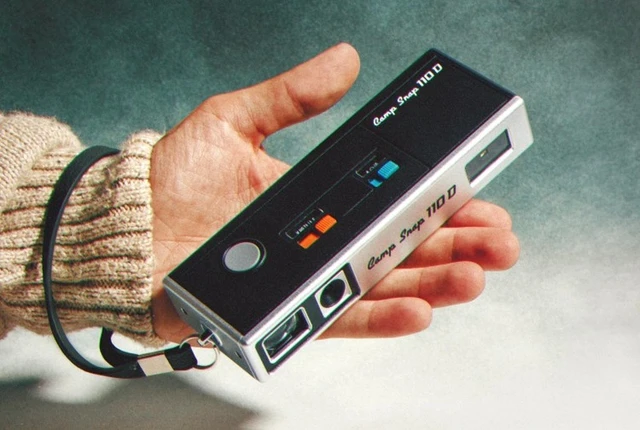
The trajectory of compact photography shifted forever in 1972 when Kodak introduced the 110 format. These cameras became emblems of accessibility—effortlessly simple to operate, they allowed anyone to document the mundane without the steep learning curve of manual settings. This specific visual and functional DNA serves as the foundation for Camp Snap’s latest offering: the 110D. Its design draws inspiration from the classic silhouettes of Canon, Minolta, and Pentax, the brands that once popularized the small-format film era.
At its core, the Camp Snap 110D is a conscious rejection of redundancy. In an era where every frame is subjected to endless retouching, this camera advocates for a return to "blind" creativity. The absence of a preview screen forces the photographer to trust their eye and composition, reintroducing an element of spontaneity and raw sincerity to the act of shooting.
The device's hardware is balanced to sustain a retro aesthetic without compromising fundamental quality. Imaging is handled by an 8-megapixel Sony CMOS sensor with a physical size of 1/3.2 inches. Paired with a 4.2mm lens and an ƒ/2.0 aperture, the result is a characteristic softness highly prized in amateur photography. A notable addition is the support for 30.5mm external filters, enabling experimentation with lighting and color rendering long before the digital post-processing stage.
For those seeking the authentic patina of vintage prints, the camera integrates five software filters. These simulate vignetting, the distinct color shifts of analog film, and classic monochrome imagery. Control over these effects is managed via a physical slider switch, emphasizing the device's tactile nature and distancing it from the ubiquity of touch interfaces.
From a pragmatic standpoint, the 110D is engineered for maximum convenience. Data is stored on a 4GB microSD card, accommodating up to 2,000 frames. The slot is secured by a screw-down door—a design choice that prevents accidental ejection while lending the device a sense of mechanical robustness. Data transfer is handled via a modern USB Type-C interface, ensuring seamless synchronization with PCs or mobile devices.
Power autonomy is provided by an 800 mAh battery, sufficient for approximately 500 shots. To minimize power drain, an automatic sleep mode has been implemented. Essential information is relayed via a minimalist segment LCD on the rear panel, displaying only critical parameters: remaining battery life and the shot count.
Completing the package is a built-in flash with adjustable color temperature, allowing the light to be tailored to the specific mood of the scene. Available in black and white-orange colorways, the Camp Snap 110D is positioned not merely as a gadget, but as a tool for "slow photography," inviting the user to decelerate and view the world through the aesthetic prism of the past.
 The Patent Battle Over Spatial Audio