The modern mobile computing landscape demands a surgical balance between peak performance and energy efficiency. In response to this challenge, AMD is aggressively expanding its portfolio, integrating a suite of new solutions into the Hawk Point family. Eleven new models, spanning the Ryzen 100 and 200 series, underscore the company's ambition to saturate every available market niche. However, this expansion is coupled with a convoluted naming convention that effectively blurs the boundaries between chip generations.
AMD's strategy in the mobile processor segment is becoming increasingly fluid, yet simultaneously more opaque for the end consumer. The latest update to the Hawk Point lineup introduces eleven new models, split between two primary families: the Ryzen 100 and Ryzen 200 series. This move signals the company's attempt to establish a tiered product ecosystem where technical specifications do not always follow a linear progression relative to the series index.
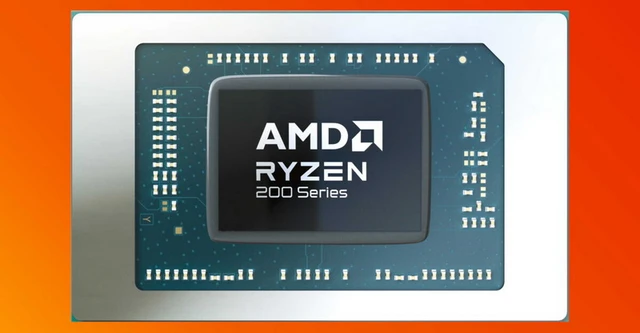
The Ryzen 200 series has become the primary vehicle for implementing a hybrid core architecture. This lineup includes the Ryzen 7 253, 249, and 217, alongside the Ryzen 5 225, 224, 216, and the Ryzen 3 205. The technological foundation here is built on Zen 4 cores, with several models pairing them with Zen 4c efficiency cores. The latter are compact versions of the full-performance cores; they maintain the same instruction set but feature a smaller cache and lower clock speeds, allowing for significantly higher core density on the die without a critical spike in power consumption.
The Ryzen 3 205 warrants particular attention due to its unconventional thread configuration. The chip is equipped with six cores but supports only eight threads. This is achieved through a combination of two full-performance Zen 4 cores and four compact Zen 4c cores. Across the entire 200 series, the graphics subsystem is based on the modern RDNA 3 architecture, delivering competent performance for visualization tasks and light gaming.
The situation with the Ryzen 100 series is more ambiguous, rendering the lineup a sort of heterogeneous patchwork of different generations. Originally, the series consisted of models based on the 6nm Rembrandt process (Zen 3+ cores and RDNA 2 graphics), such as the Ryzen 7 170 and 160, Ryzen 5 150 and 130, and the Ryzen 3 110. However, new Hawk Point representatives have now been added to this same row: the Ryzen 9 180, Ryzen 7 165 and 155, and the Ryzen 5 125. These newer entries are manufactured using the more advanced 4nm process and feature RDNA 3 graphics.
This blending of technologies within a single series has led to a certain level of disarray in the documentation. On AMD's official pages, some of the new Ryzen 100 models are erroneously labeled as Zen 3+ solutions, despite technical specifications (the 4nm process and RDNA 3) clearly indicating they belong to the Hawk Point family. This suggests that the marketing nomenclature has begun to outpace internal database updates.
Parallel to the global market, AMD is developing a specialized branch of H-series processors exclusively for China. Most of these chips, such as the Ryzen 9 H 270 or Ryzen 5 H 220, are mirror images of their global counterparts. However, this lineup features the unique Ryzen 7 H 255. It boasts eight full Zen 4 cores with a base clock of 3.8 GHz and a boost up to 4.9 GHz, while its Radeon 780M graphics accelerator runs at 2.6 GHz, making it one of the most powerful solutions in its class for the regional market.
Ultimately, AMD's current policy demonstrates a trend toward the blurring of distinct architectural boundaries. Consolidating Rembrandt, Hawk Point, and hybrid Zen 4/4c configurations into shared families streamlines portfolio management for the manufacturer, but complicates the analysis for the user. Even in official specifications, the company no longer consistently emphasizes the specific architecture underlying a given die, shifting the focus from granular technical details to the product's general standing within the brand hierarchy.
 iPhone 17: Dominating the Global Market