The global race for AI supremacy is fundamentally reshaping the requirements for server infrastructure. Modern data centers are evolving into monolithic neural networks, where core density and memory bandwidth have become the critical determinants of operational efficiency. In response, AMD has unveiled a strategic roadmap for its EPYC processor family extending through 2030—a vision that signals a pivot toward sub-2nm fabrication processes and the deep integration of specialized AI instruction sets.
The evolution of AMD's server solutions has entered a phase of aggressive scaling. With the debut of the Zen 6 series, codenamed Venice, the company is effectively redefining the parameters of the x86 landscape. For the first time, the industry is facing a 2nm processor capable of supporting up to 512 threads. This leap in compute density is made possible by the integration of PCIe Gen 6 and support for JEDEC MRDIMM memory, eliminating the data transfer bottlenecks that have constrained the potential of multi-core systems for decades.
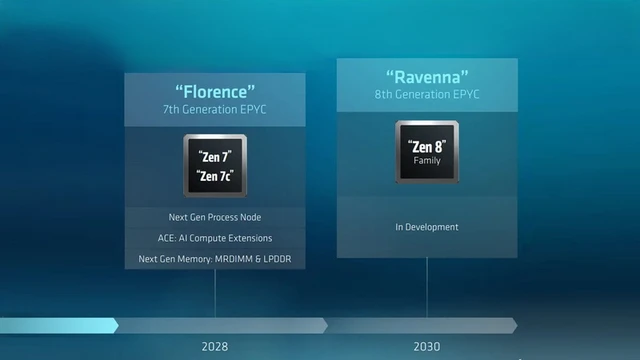
The technological breakthrough of Venice lays the groundwork for the next milestone: Zen 7 (Florence), slated for release in 2028. AMD is expected to transition to a next-generation process node here, most likely based on TSMC’s A14. The primary focus for Florence will be intelligent optimization; the introduction of ACE AI instructions will allow processors to handle machine learning tasks more efficiently directly at the core level, reducing reliance on external accelerators.
Parallel to the surge in raw computing power, there will be a qualitative leap in data management. The transition to DDR6 and LPDDR6 standards will provide bandwidth far beyond the capabilities of current DDR5 modules. To ensure deployment flexibility, AMD will maintain its hybrid approach, offering both full-performance Zen 7 cores and their compact counterparts (Zen 7c), optimized for maximum density within data center racks.
The application spectrum for Florence spans a wide array of scenarios: from traditional general-purpose enterprise workloads to specialized host nodes for agentic AI. The latter is particularly critical, as autonomous AI agents require massive resources to maintain context and facilitate real-time decision-making. AMD's ambitions in this arena are underscored by its pursuit of industry-leading core counts, signaling that the 256-core benchmark set by Venice is merely a waypoint toward even more massive dies.
Capping this long-term trajectory is Zen 8 (Ravenna), scheduled for release in 2030. While detailed specifications for this series remain classified, the mere fact of planning a decade ahead demonstrates the company's confidence in its technological superiority and its ability to sustain the pace of Moore's Law, even amidst the physical constraints of silicon.
 The Triumph of 3nm Chip Manufacturing