The global AI arms race has decisively shifted into the realm of hardware, where memory bandwidth and compute density have emerged as the primary determinants of success. As modern neural networks demand staggering resources for both training and inference, manufacturers are being forced to fundamentally reimagine the core principles of chip architecture. AMD is making a strategic leap forward with the unveiling of the Instinct MI455X accelerator—a product engineered to directly challenge Nvidia's market hegemony. This release embodies a broader transition toward next-generation memory standards and hybrid semiconductor fabrication techniques.
The new Instinct MI455X flagship is built upon the CDNA 5 architecture, engineered specifically for large-scale AI training and high-performance inference within rack-scale systems. The primary technological breakthrough is the integration of 432 GB of HBM4 memory, enabling a peak bandwidth of 23.3 TB/s. In an era of "data starvation," where compute power often sits idle waiting for information from memory, such metrics are critical for the efficiency of Large Language Models (LLMs).
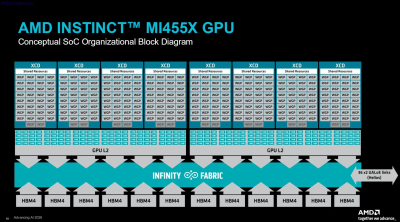
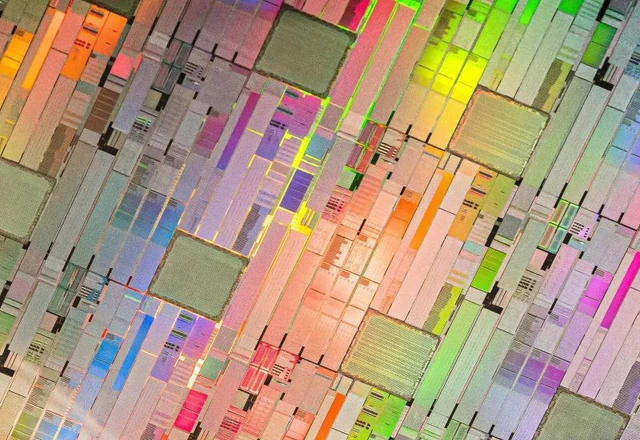
The chip's hardware implementation showcases the pinnacle of modern semiconductor engineering: AMD has adopted a hybrid manufacturing approach. Rather than utilizing a single process node for the entire die, the device consists of several specialized chiplets. Eight Accelerator Complex Dies (ACD), housing 256 Workgroup Processors (WGP), are fabricated using TSMC’s cutting-edge 2nm N2 process. Meanwhile, two Fabric chiplets—responsible for data transport and caching—and two I/O modules are produced using the TSMC N3P 3nm process. This strategy optimizes both cost and die yield while maintaining a massive overall transistor density of 320 billion.
The HBM4 memory is implemented via a 192-channel interface across 12 stacks, ensuring an unprecedented level of interaction between data and compute cores. To minimize latency, the architecture includes a 192 MB global L2 cache, split into two independent 96 MB blocks. In terms of connectivity, the accelerator supports the modern PCIe Gen 6 standard or can be integrated via three AMD AI-NIC network adapters using the UALink protocol—a move that serves as a direct response to the closed ecosystems of its competitors.
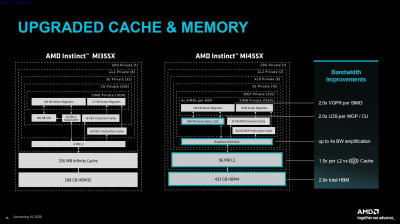
The performance of the MI455X represents a quantum leap over its predecessor, the MI355X. In MXFP8 and MXFP6 operations, the device achieves 20.13 PFLOPS, while scaling up to 40.26 PFLOPS when utilizing the MXFP4 format. Effectively, the new accelerator delivers a fourfold increase in performance in these modes, while offering 1.5 times more memory and nearly triple the bandwidth.
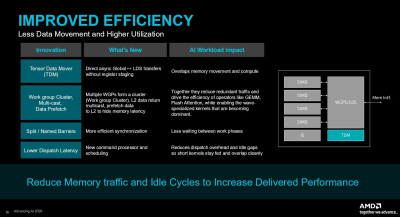
The evolution of CDNA 5 introduces several pivotal functional enhancements. The implementation of the Tensor Data Mover enables direct asynchronous data transfers between global memory and local storage, significantly offloading primary compute resources. Additionally, the architecture introduces workgroup clustering mechanisms, data multicasting, and an updated command processor designed to minimize instruction dispatch latency.
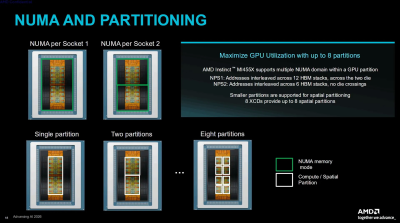
Operational flexibility for the MI455X is ensured through support for spatial partitioning. The accelerator can operate in single, dual, or eight-partition modes. For instance, NPS1 mode provides uniform address interleaving across all twelve HBM4 stacks, whereas NPS2 divides the GPU into two independent domains of six stacks each, eliminating cross-die data transfers to optimize local computations.
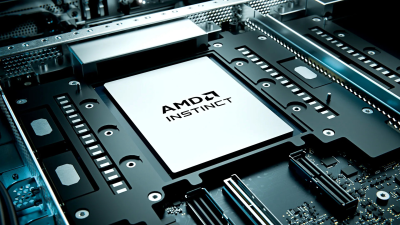
Alongside the primary flagship, AMD introduced the Instinct MI430X. This accelerator is tailored for specialized workloads: scientific computing, "sovereign AI," and hybrid AI-HPC scenarios. In double-precision tasks (FP64), it delivers 288 TFLOPS, making it a powerful tool for simulations and complex mathematical modeling where computational precision outweighs the raw speed of neural network weight processing.

 The Triumph of 3nm Chip Manufacturing