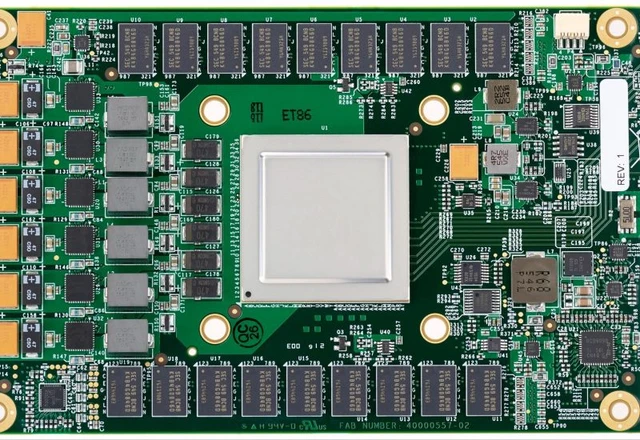
The AI industry is undergoing a fundamental paradigm shift, transitioning from the era of training monolithic models to a phase of large-scale deployment and operationalization. In this landscape, inference—the process of generating outputs from pre-trained networks—has become critical; latency and power efficiency are now the primary determinants of a product's commercial viability. AMD’s acquisition of the Canadian startup Taalas is a key component of a broader strategy to develop specialized accelerators. This move underscores a clear market trajectory: a pivot away from general-purpose hardware in favor of extreme optimization tailored to specific algorithmic workloads.
The contemporary AI compute market is gradually evolving beyond the "brute force" era dominated by general-purpose GPUs. The focus has shifted toward execution efficiency, and it is here that AMD sees immense potential in the technology developed by Canadian startup Taalas. The core of the startup's approach lies in deep hardware mapping, binding specific neural network models directly to the chip's architecture. Unlike traditional GPUs designed for general computation, Taalas solutions effectively translate a model's mathematical logic into physical silicon topology, drastically slashing both latency and power consumption.
This paradigm shift yields an exponential leap in performance; in certain scenarios, efficiency gains can exceed those of general-purpose GPUs by several orders of magnitude. Memory architecture is central to this success: Taalas chips utilize integrated high-speed SRAM to eliminate the traditional "bottleneck" during data transfer between compute cores and storage. This concept was validated through the optimization of accelerators for Meta’s Llama 3.1, which demonstrated exceptional throughput in real-world deployments.
A critical competitive edge for Taalas is its agility. While semiconductor development cycles typically span years, the Canadian startup claims the ability to "hardwire" any new AI model into silicon within just two months. This provides a flexible toolset amidst the rapid evolution of Large Language Models (LLMs), allowing the hardware stack to be updated almost as quickly as the software.
AMD's move is not an isolated incident but rather a reflection of broader market consolidation. Even the undisputed leader, Nvidia, has followed a similar trajectory; seven months ago, it integrated Groq—a startup valued at $20 billion—into its ecosystem. This reinforces the thesis that the future of AI infrastructure lies at the convergence of general-purpose computing and highly specialized ASICs (Application-Specific Integrated Circuits).
For AMD, integrating Taalas’ innovations into its server lineups represents a strategic augmentation. While the company continues to view general-purpose GPUs as the primary tool due to their versatility, specialized accelerators allow it to offer clients more cost-effective and efficient solutions for specific inference workloads. The production cycle remains streamlined: both Taalas and AMD leverage TSMC's fabrication capabilities, simplifying logistics and the technical integration of these new solutions into the company's broader ecosystem.
 The Price of Acceleration: CXMT’s Rapid Push into Memory