The tech industry is witnessing a fundamental paradigm shift, pivoting from cloud-centric services toward local AI execution on edge devices. This transition is redefining the very fabric of human-machine interaction, evolving the computer from a mere tool into a sophisticated cognitive partner. AMD intends to solidify its leadership in this evolution by unveiling a comprehensive new hardware roadmap; the upcoming IFA exhibition will serve as the stage for a manifesto on the future of personal artificial intelligence.
Since its inception in 1924 as a showcase for radio electronics, Berlin's IFA has evolved over the past century into a global barometer for consumer trends. As the event's focus shifts toward mobile devices and smart home ecosystems, the "Computing and Gaming" zone has taken on heightened significance. This is where the battle for laptop performance, GPU dominance, and handheld systems is fought, making it the ideal venue for AMD’s strategic reveals.
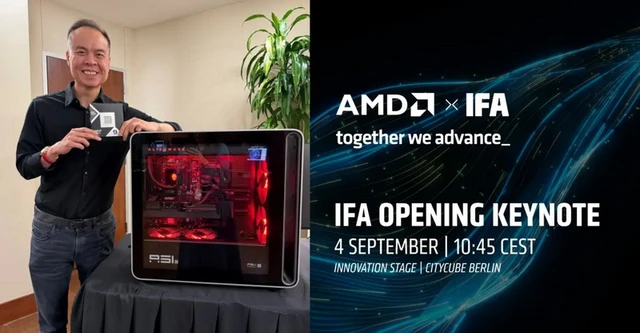
The centerpiece of the event will be a keynote by Jack Huynh, who oversees the computing and graphics division. His presentation, titled "The Era of Personal AI: The Future of Imagination," signals a profound transformation in processor architecture. This is not merely about pushing clock speeds; it is about engineering an ecosystem where artificial intelligence is baked directly into the silicon. By enabling complex tasks to be processed locally rather than relying on remote servers, AMD aims to address critical concerns regarding data privacy and latency when running generative models.
Industry insiders expect AMD to unveil an updated lineup of Ryzen processors optimized for neural networks. The focus will likely center on the evolution of the current Zen 5 platform, which is expected to feature enhanced NPU (Neural Processing Unit) capabilities to accelerate AI workloads. While the market eagerly anticipates the next generation of chips based on Zen 6 or new Radeon 10000 GPUs featuring RDNA 5, the current refresh cycle suggests that the company is prioritizing the refinement and perfection of its existing solutions.
This strategic direction underscores a broader global shift: the transition from "cloud intelligence" to "personal intelligence." In this paradigm, computational power is moved as close to the end-user as possible, unlocking new horizons for creativity and professional productivity. AMD’s objective is to create an environment where hardware ceases to be a bottleneck and instead becomes a transparent conduit for human imagination.
 Breaking the Lithography Barrier in China