The software engineering landscape is undergoing a paradigm shift, moving beyond rudimentary chatbots toward sophisticated agentic systems. In this new era, the quality of the output is dictated not by the raw capacity of a single model, but by the orchestration of the workflow itself. Anthropic’s latest update to Claude Code epitomizes this transition, swapping linear prompting for a multi-tiered analysis pipeline. Rather than merely attempting to extend the model's "reasoning" window, the company has implemented a hierarchy of specialized verification pipelines—a strategic move designed to mitigate the inherent cognitive biases AI encounters when auditing its own code.
The conventional paradigm for leveraging Large Language Models (LLMs) in software engineering has long been limited to single-prompt interactions: a developer requests a code review, and the model provides an answer based on its current context window. Anthropic has fundamentally reimagined this approach by introducing a tiered analysis system with five levels of depth: Low, Medium, High, X-high, and Ultra. This granularity allows for precise resource management and accuracy tuning, enabling the system to pivot between a rapid surface scan and the deployment of a comprehensive verification infrastructure.
At the foundational levels—Low and Medium—the system operates primarily within localized context. While the Low tier is restricted to an express analysis of specific changes, the Medium tier integrates those changes into the broader project architecture. In Medium mode, the model executes a series of repository-wide queries to ensure that modifications do not disrupt logic in remote sections of the system, subjecting any identified anomalies to internal validation before presenting them to the user.
A fundamental shift occurs at the High level and beyond. Here, the very nature of model interaction evolves: defect detection and verification are delegated to independent sub-agents operating within a "clean" context. This is a critical architectural decision designed to combat the "anchoring effect"—a cognitive bias where a neural network tends to defend or overlook errors in code it has just generated. By decoupling the roles of "creator" and "critic," Anthropic achieves an objectivity that is unattainable within a single shared context window.
The X-high mode expands the analytical scope beyond the immediate diff. The system evaluates the downstream impact of changes across the entire codebase, predicting potential regressions in modules that were not explicitly modified during the editing process.
The pinnacle of this hierarchy is the Ultra mode, which migrates the analysis process into an isolated cloud sandbox. In this environment, Claude Code effectively clones the state of the repository or a GitHub Pull Request to create a fully functional testing environment. A group of specialized agents does not merely hypothesize the existence of a bug; they attempt to reproduce and confirm it deterministically. Currently, Ultra is in Research Preview, available to Pro and Max subscribers with a limited number of free runs, after which costs range from $5 to $20 depending on the volume of changes.
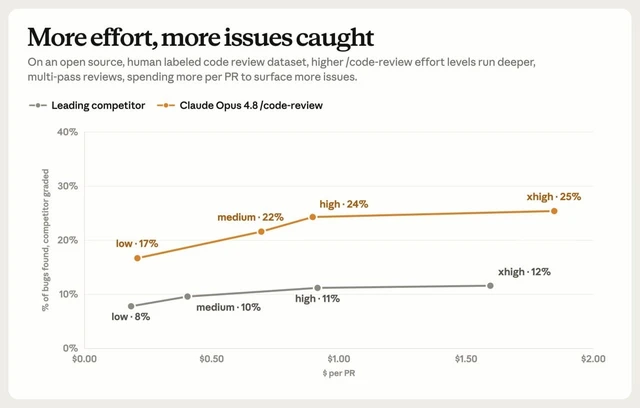
The efficacy of this approach is backed by quantitative data. In tests using manually annotated open-source benchmarks, the Claude Opus 4.8 model demonstrated a consistent increase in precision: bug detection rates climbed from 17% at the Low level to 25% at X-high. For comparison, competing systems in similar modes yielded results between 8% and 12%, underscoring the superiority of an agentic architecture over simple parameter scaling.
Notably, Anthropic has already integrated Ultra Review into its own internal development workflows, utilizing the mode as the final quality gate before merging any pull request. This signals a transition toward a new philosophy of software engineering: AI is evolving from a conversational assistant into a comprehensive quality assurance pipeline, where every stage of analysis is executed by a specialized agent within a strictly defined process.
 Intel’s Strategic Play for Advanced Packaging Supremacy