The global race for AI supremacy has fundamentally shifted; the battleground is no longer defined by algorithmic breakthroughs, but by the mastery of physical infrastructure. For the United States, establishing a vertically integrated production cycle for high-tech hardware has evolved into a strategic imperative for both national security and economic resilience. The opening of Wistron’s facility in Texas marks a decisive pivot away from reliance on Asian manufacturing hubs toward the cultivation of an autonomous technological cluster—a move that lays the essential groundwork for the large-scale deployment of next-generation computing systems.
Efforts to onshore high-tech manufacturing are not a new phenomenon; as early as 2017, the Trump administration attempted to lure Foxconn, though those initiatives failed to gain the expected traction. Today, however, the landscape has shifted: market pragmatism and geopolitical imperatives have rendered localization an inevitability. Leading the charge is Wistron, which has established a massive facility in Texas spanning over 30,000 square meters. With an investment of $700 million, this plant serves as the company's first full-scale American asset, designed to radically shorten the logistical gap between production and the end consumer.
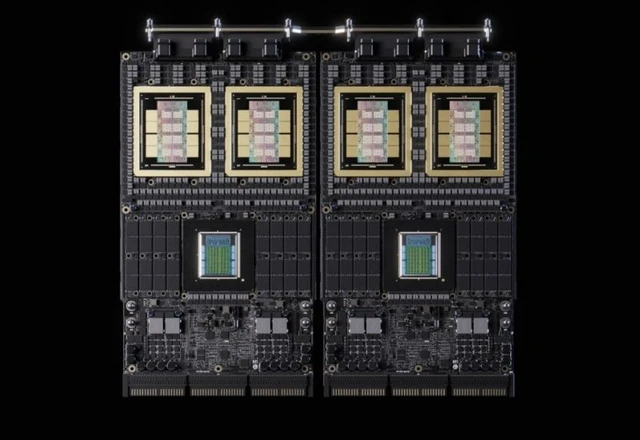
The centerpiece of the opening ceremony was an Nvidia GB300 module, assembled directly on the Texas site. The facility's technological roadmap will unfold in stages: initial capacity will focus on Grace Blackwell-based server systems, with the strategic objective of transitioning to Vera Rubin generation solutions. In the chip industry, Vera Rubin represents the next evolutionary leap beyond Blackwell; the ability to assemble such systems within the U.S. transforms the Fort Worth plant into a critical node in Wistron's global infrastructure.
Nvidia CEO Jensen Huang emphasizes that the anomalous demand for AI servers necessitates a decentralization of manufacturing. The "single global hub" model is no longer viable; systems must be produced ubiquitously to ensure supply chain resilience. For too long, American customers were beholden to Taiwanese exports of printed circuit boards (PCBs) and finished accelerators. Now, Wistron—and its rival Foxconn, which is also preparing a site in Houston—are establishing a comprehensive production cycle: from the fabrication of complex PCBs to the assembly of complete GPU server racks.
However, the true significance of this development emerges when viewing the industry's broader architecture. In Arizona, TSMC is scaling its wafer fabrication and chip packaging capabilities, effectively closing the loop on the creation of the system's "heart." The sole remaining vulnerability is HBM (High Bandwidth Memory), where Micron currently maintains dominance. Nevertheless, regulatory pressure on Korean giants Samsung and SK hynix to localize production in the U.S. underscores Washington's drive toward total technological self-sufficiency.
Consequently, we are witnessing the emergence of a vertically integrated cluster within a single nation: spanning from lithography and semiconductor packaging to the final assembly of the most sophisticated computing complexes. This is more than mere business expansion—it is a fundamental restructuring of the global division of labor in the era of generative AI.
 Energy Autonomy: The Extreme Edition