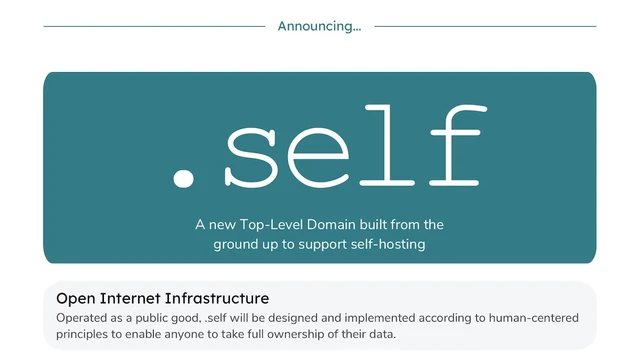
The modern internet has devolved into a constellation of walled gardens, where user data has been commoditized into the primary currency of exchange. Amidst the absolute hegemony of SaaS platforms and the rise of "surveillance capitalism," there is an urgent imperative for tools that enable genuine digital autonomy. The Human-Centered Computing Foundation (HCCF) is proposing a radical intervention: the introduction of a new top-level domain, .self. This initiative aims to restore individual agency over digital identity, shifting the paradigm of the web from a landscape of rented access to one of sovereign ownership.
The vision for the .self top-level domain transcends the mere expansion of the internet's address space; it represents a fundamental attempt to rewrite the social contract between the user and the underlying infrastructure of the web. At its core, the initiative led by the Human-Centered Computing Foundation (HCCF) is a challenge to the prevailing economic paradigm of the digital age—one where privacy is routinely sacrificed for corporate profit and users find themselves trapped within proprietary ecosystems.
The cornerstone of this new concept is the promotion of self-hosting. In an era dominated by the "Software as a Service" (SaaS) model, users effectively cease to own their digital footprints, instead renting space on third-party servers. The transition to a .self model envisions an environment where the infrastructure is owned by the individual, thereby eliminating the threat of censorship or the arbitrary deletion of accounts by a corporate algorithm.
Executing such an ambitious plan requires strategic engagement with ICANN (the Internet Corporation for Assigned Names and Numbers), the de facto governing body of the global DNS. By joining ICANN's applicant support program, the HCCF can significantly lower the financial barrier to entry for registering a new top-level domain, bypassing the standard $227,000 fee. This allows the non-profit organization to prioritize its social mission over profit extraction.
The economic framework for name distribution is particularly noteworthy. The HCCF intends to make .self domain registration free of charge—a strategic blow to the cybersquatting market. In traditional domain zones, speculators hoard promising names to flip them for exorbitant sums. A free model completely nullifies the investment incentive for resellers, ensuring that domains are distributed based on actual user needs rather than market manipulation.
From a linguistic and sociological perspective, the prefix "self" is already deeply embedded in the modern digital lexicon. Frequency analysis suggests that such constructions are already organically perceived by users, which will likely streamline the adoption of this new standard.
Ultimately, .self aspires to be more than just a technical address; it is a digital manifesto. It is an attempt to create a safe harbor for those seeking decentralization and the reclamation of privacy, transforming the internet from an instrument of surveillance into a space of genuine human autonomy.
 The Price of Acceleration: CXMT’s Rapid Push into Memory