Modern science is grappling with a reproducibility crisis and an overwhelming deluge of data—a volume that has far exceeded the processing capacity of the human mind acting in isolation. Against this backdrop, artificial intelligence is evolving beyond its role as a mere text generator, emerging instead as a sophisticated methodological architect and research coordinator. The advent of Claude Science signals a paradigm shift: moving away from basic conversational interfaces toward the realization of autonomous digital laboratories. AI is now stepping into the role of a systems integrator, synthesizing vast global knowledge bases with rigorous verification protocols to ensure the integrity and validity of scientific outcomes.
Anthropic has unveiled Claude Science, a specialized environment for computational research that fundamentally reimagines how scientists interact with data. It is critical to understand that this is not a standalone neural network, but rather a sophisticated orchestration layer built upon existing models within the Claude family. The platform transforms standard AI into a comprehensive digital laboratory capable of interfacing with over 60 domain-specific scientific databases.
At the core of the system lies a multi-agent architecture designed to mimic the hierarchy of a physical research institute. The primary assistant functions as a lead researcher or project manager; rather than simply answering queries, it delegates tasks to highly specialized sub-agents. These "digital employees" can be created for specific objectives or summoned from pre-configured toolsets for genomics, chemistry, and protein structure analysis. The final and most critical link in the chain is a dedicated AI fact-checker, which verifies all citations and calculations prior to final publication.

This approach is designed to tackle one of the primary hurdles of LLM application in science: the propensity for hallucinations. In an academic setting, a fabricated reference or a statistical error can discredit an entire body of work. However, it is worth noting that even this verification process is handled by the same underlying model rather than an external, independent source of truth, leaving some room for caution.
The developers have paid particular attention to the problem of reproducibility—the "holy grail" of modern science. Claude Science does not merely deliver a result; it packages it within a comprehensive contextual container. Any generated graph or 3D protein model is accompanied by its source code and the precise software environment configuration used during its creation. This allows other researchers to replicate the process and achieve identical results, eliminating the factors of randomness or interpretational error.
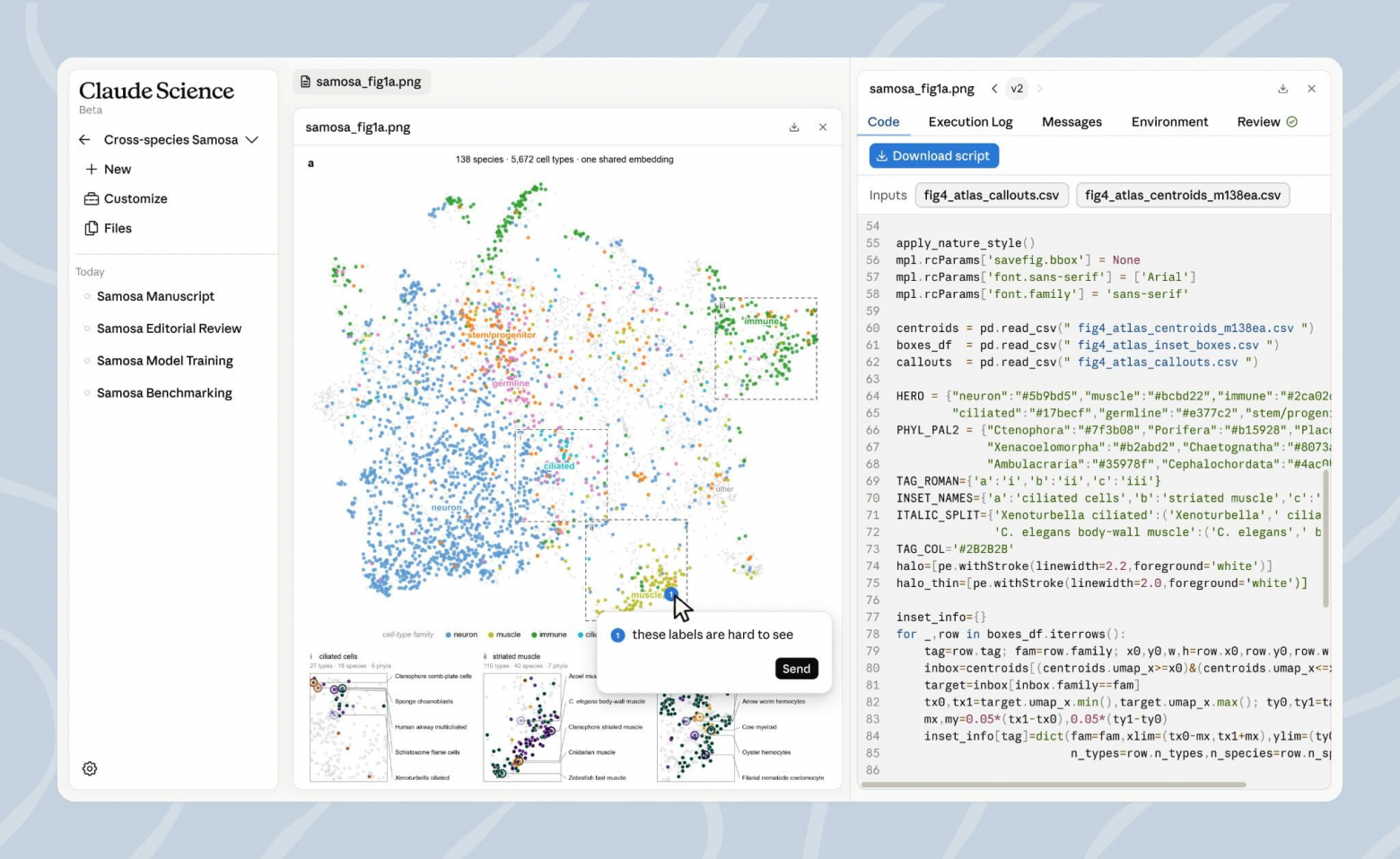
The environment's interactivity allows for the refinement of complex visualizations using natural language: a scientist can request changes to graph parameters, and the AI agent automatically updates the underlying code. Furthermore, to ensure the security of confidential data, the platform supports on-premises deployment on laboratory servers, eliminating the need to transmit sensitive information to Anthropic’s external clouds.
This release is the logical evolution of the Claude for Life Sciences project launched in autumn 2025. The tool has now transitioned into a standalone product, joining the ranks of solutions like Claude Code and Claude Cowork. This is a clear signal of the company's intent to establish a foothold in academia and build a reputation as a reliable partner for fundamental science.
A strategic confrontation is currently unfolding between three giants, each pursuing a different path toward scientific expansion. Anthropic is betting on democratization and broad reach via accessible subscriptions. In contrast, OpenAI has opted for narrow corporate specialization with its GPT-Rosalind model, granting access only to a select circle of pharmaceutical titans and research centers, such as Moderna or Amgen, following rigorous security vetting.
Google DeepMind holds the strongest position, possessing foundational models like AlphaFold and AlphaGenome. Their Gemini for Science platform does not merely utilize external tools; it integrates proprietary developments that have effectively become the industry standard in biology.
The divergence in these corporate strategies—ranging from mass access to closed corporate partnerships and ownership of base models—is defining the trajectory of the entire AI market. It is likely that we will see similar competitive scenarios unfold soon in other high-tech verticals: law, finance, and complex engineering design.

 Anthropic’s Strategic Push for Hardware Independence