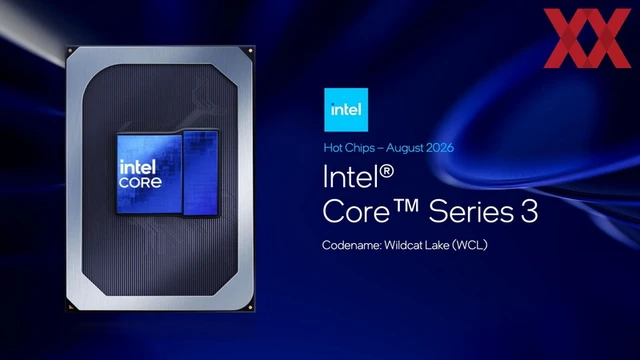
The contemporary AI arms race is pivoting from the training phase toward mass inference. The critical constraint is no longer raw computational throughput, but rather the memory capacity required to host gargantuan language models. Intel is proposing a radical paradigm shift, eschewing cost-prohibitive standards in favor of superior scalability. Project Crescent Island seeks to fundamentally redefine the economics of neural network deployment within the data center.
At the Hot Chips 2026 conference, Intel unveiled the details of Crescent Island—a specialized accelerator designed to disrupt the AI inference landscape. While the industry has largely been locked in a race for peak TFLOPS, Intel has pivoted to address a more fundamental bottleneck: the cost and availability of memory when deploying large-scale models.
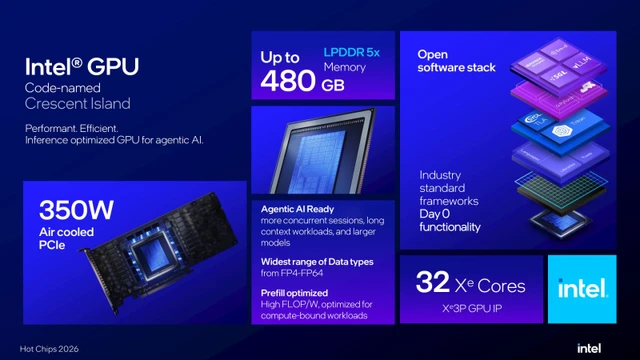
The architectural backbone of Crescent Island is a GPU compute core featuring 32 Xe3P cores, organized into four Compute Slices. Each slice integrates eight cores working in tandem with 256 XMX (Xe Matrix eXtensions) vector and matrix engines. These XMX blocks handle the heavy lifting for the tensor operations that underpin modern neural networks. To minimize latency, Intel has implemented a sophisticated multi-tier caching hierarchy: each Xe core is equipped with 512 KB of unified L1 cache and Shared Local Memory (SLM), totaling 16 MB, complemented by a 32 MB shared L2 cache.
The Xe3P architecture represents a significant evolution of the Xe3 family, with a primary focus on power efficiency and raw computational throughput. In a bold move to optimize the transistor budget, Intel engineers completely stripped the chip of traditional 3D graphics hardware. This reclaimed silicon real estate allowed for expanded compute resources and the integration of a broad spectrum of data formats—ranging from ultra-lightweight FP4, ideal for rapid inference, to high-precision FP64 for complex scientific workloads.
However, the true innovation of Crescent Island lies in its memory strategy. While the industry has largely converged on HBM (High Bandwidth Memory) for its massive throughput, HBM remains prohibitively expensive and technologically complex. Intel has taken a different path, opting instead for LPDDR5X. Although LPDDR5X cannot match HBM in raw bandwidth, it enables a dramatic increase in memory capacity while maintaining moderate costs and power consumption.
The reference implementation will feature 160 GB of memory, though an open specification will allow partners to scale configurations up to 480 GB. This approach addresses a critical pain point: it enables massive large language models (LLMs) to reside entirely on a single accelerator, supporting longer context windows and serving a higher density of AI agents without the need to shard models across multiple devices.
Crescent Island does not aim to lead in neural network training, where memory bandwidth is the primary determinant of performance. Instead, its objective is the most cost-effective and efficient token generation possible. Intel is betting on operational expenditure (OpEx) and ease of integration. Delivered as a PCIe card with a 350W TDP, the device supports standard air cooling, meaning these accelerators can be deployed into existing server infrastructure without the costly transition to liquid cooling systems.
In effect, Intel is carving out a new market niche. Rather than competing in a raw power race, the company is offering a balanced solution where memory capacity and total cost of ownership (TCO) become the primary competitive advantages. In large-model inference scenarios, the ability to maintain the entire context in memory often proves more valuable than peak computational speed.
The first samples of Crescent Island are expected in the second half of 2026. While precise performance benchmarks remain confidential, the device's core philosophy signals Intel's commitment to making AI infrastructure more accessible and scalable for real-world enterprise applications.
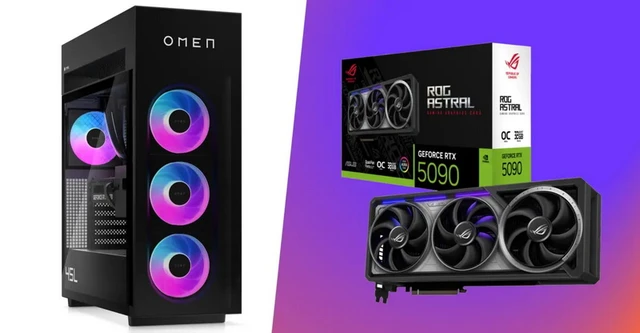 The Economic Paradox of the GeForce RTX 5090