The global explosion of artificial intelligence is radically redrawing the contours of the semiconductor industry. Market leaders have pivoted their focus toward developing ultra-high-speed memory tailored for data centers, effectively leaving the consumer segment in a state of strategic neglect. Stepping into this vacuum, China's CXMT is rapidly ascending, scaling its manufacturing capabilities to rival those of established global incumbents. This tectonic shift threatens to fundamentally disrupt pricing structures and the availability of system memory for millions of end-users worldwide.
The modern semiconductor market is undergoing tectonic shifts. The three dominant DRAM players have been forced to pivot their priorities, channeling nearly all available resources into massive data center projects. The insatiable appetite for High Bandwidth Memory (HBM)—essential for neural networks and GPU accelerators—has pushed the traditional consumer segment to the periphery of these tech giants' attention.
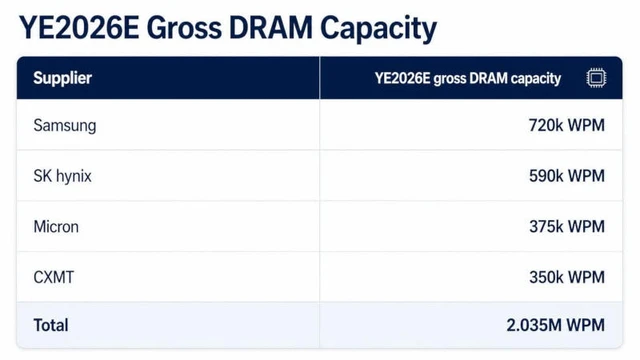
In this vacuum, ChangXin Memory Technologies (CXMT) is evolving from a regional contender into a formidable global competitor. The company's growth trajectory is staggering: while production volumes stood at a mere 40,000 DDR4 wafers per month in 2020, by the end of 2025, the company has reached 720,000 wafers per quarter. According to Citrini analysts, CXMT aims for monthly volumes between 350,000 and 375,000 wafers by the end of 2026. This pace of expansion effectively places the company on equal footing with Micron, one of the industry's pillars.
This rapid ascent was made possible by a perfect storm of market factors. The AI boom triggered a surge in memory pricing, providing manufacturers with significant profit margins and removing the capital constraints hindering fab expansion. While Western firms focus on pushing the boundaries of technological achievement, CXMT is efficiently capturing the mass-market niche.
The tangible impact of this shift is already being felt in the consumer sector. Major brands, such as Corsair, have begun incorporating CXMT chips into their memory modules. This strategic move helps curb the skyrocketing prices of modern DDR5 products, which would otherwise remain inaccessible to a broad user base due to capacity shortages among traditional market leaders.
Despite these gains, a technological divide persists. Currently, CXMT lacks the capability to produce high-end DDR5 chips or the specialized HBM memory that serves as the "gold standard" for AI infrastructure. However, for the average consumer, absolute speed is often secondary to affordability and supply chain stability.
Looking ahead, CXMT’s ambitions are even more aggressive. By 2030, the company could reach a production volume of 950,000 wafers per month, cementing its status as China's largest memory manufacturer and allowing it to compete fully with global leaders. Consequently, the DRAM market is ceasing to be an exclusive oligopoly of a few corporations, shifting toward a multipolar model where technological accessibility is defined not only by innovation but by industrial scale.
 Energy Autonomy: The Extreme Edition