The modern tech landscape is hurtling toward the total dematerialization of content, systematically replacing true ownership with the mere leasing of access. Sony’s decision to phase out physical media for PlayStation marks another milestone in the twilight of the disc era. In a striking counter-response to this trend, GitHub has introduced an unexpected and deeply symbolic gesture: a proposal to migrate source code from the cloud back onto CD-ROMs. This move underscores a fundamental tension regarding ownership rights within our current era of digital ephemerality.
The global technology landscape is witnessing the final severance of its ties with physical media. The definitive coda to this era came with Sony's announcement that it will cease production of discs for PlayStation consoles by January 2028. This move effectively closes the chapter on the decades-long history of material software and game distribution, shifting the user-product interaction entirely into the realm of cloud services and digital licenses.
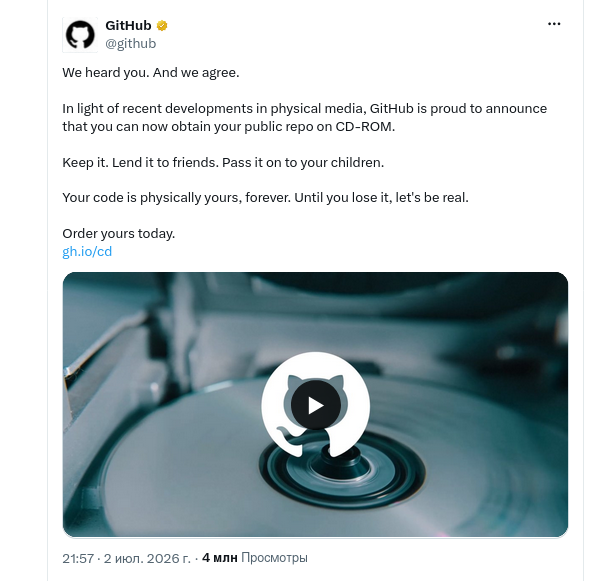
Against this backdrop, GitHub's response feels less like a marketing ploy and more like a cultural protest or an ironic manifesto. The platform has offered developers the opportunity to materialize their labor by migrating public repositories from virtual space onto classic compact discs. The "GitHub CD" project grants a select group—a mere thousand lucky participants—the chance to obtain a physical copy of their code that can be held in one's own hands.
There is a profound analytical commentary on the nature of ownership embedded in this gesture. In the modern era, "owning" a digital object often amounts to nothing more than holding a download right—a privilege that can be revoked by a provider at any moment. Transferring code to a CD-ROM restores the developer's status as a true owner: the data becomes autonomous, decoupled from servers, internet connectivity, and corporate whims. It transforms software into an artifact—something that can be archived or passed down as an heirloom, despite the inherent risk of physical degradation.
From a technical standpoint, the initiative is tightly constrained. The application window is exceptionally narrow, running only from July 2 to July 6, 2026. Due to the complexities of production and logistics, the number of discs is strictly limited, and delivery availability depends on regional constraints.
Such an experiment highlights the community's growing appetite for tangibility in a world where meaning is increasingly reduced to a sequence of bits on a remote server. GitHub is effectively reminding the industry that true data preservation is ensured not merely by cloud backups, but by the capacity for physical control over information.

 The Price of Acceleration: CXMT’s Rapid Push into Memory