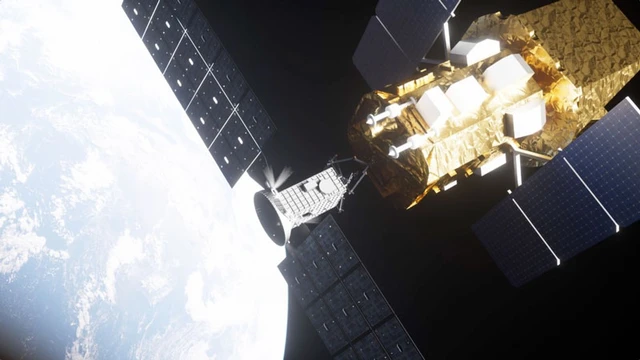
The global race for satellite communication dominance is entering a fundamentally new phase of scaling. SpaceX is not merely aiming to expand its coverage; it seeks to radically redefine the very nature of space-based data transmission, narrowing the performance gap between orbital networks and terrestrial fiber optics. An ambitious roadmap to deploy hundreds of thousands of new satellites is transforming Starlink from a niche service for remote regions into a critical backbone for global AI infrastructure. However, such aggressive expansion raises urgent concerns regarding ecological security and the preservation of the night sky.
The current stage of Starlink's evolution marks a pivotal transition from quantitative expansion to a qualitative leap. SpaceX's application to the U.S. Federal Communications Commission (FCC) to launch an additional 100,000 third-generation (Gen 3) satellites is not merely a constellation expansion; it is a strategic bid to increase the system's total throughput a hundredfold. While the current fleet of ten thousand satellites established a viable network, this new scale is designed to transform it into the dominant backbone of global data traffic.
To date, the Starlink user experience has remained inconsistent. Despite advertised peak speeds of 300–400 Mbps, real-world performance on the most premium tiers often stabilizes between 145–170 Mbps for downloads, with upload speeds frequently dipping below 40 Mbps. Compared to modern terrestrial fiber-optic solutions capable of exceeding 2 Gbps, satellite internet still feels like a compromise. This is precisely the technological divide SpaceX intends to bridge with Gen 3, targeting gigabit speeds and a reduction in latency from the current 30–50 ms to sub-20 ms levels.
Executing this vision requires a fundamental overhaul of orbital logistics. Third-generation satellites will be significantly more massive, with weights reaching approximately two tons. This renders the proven Falcon 9 inefficient, as it cannot deploy a sufficient number of such heavy payloads per launch. The linchpin of this strategy is Starship. The synergy between the super-heavy rocket—powered by Raptor 3 engines—and the new satellite iteration will allow SpaceX to deploy its network on an industrial scale, effectively turning space into a high-throughput assembly line.
The company's strategic objectives extend far beyond providing internet to residential users or the corporate sector. In its filings, SpaceX explicitly highlights a focus on government contracts and, more critically, the servicing of "billions of AI-enabled devices." In an era of Edge Computing expansion and distributed neural networks, the need for ubiquitous, ultra-high-speed connectivity is becoming critical. Starlink Gen 3 is envisioned as the "nervous system" for global AI, facilitating instantaneous data exchange between sensors, autonomous systems, and cloud computing nodes anywhere on the planet.
The technical implementation of such data volumes necessitates an unprecedented expansion of the spectral footprint. SpaceX is requesting access to a vast array of bands: from the standard Ku and Ka to the higher-frequency V, E, W, and D bands. Particularly notable are the requests for frequencies ranging from 231.5 to 275 GHz for uplink transmissions. To ensure high-speed trunking between stations, the company is asking regulators to permit the creation of larger contiguous channels, which effectively demands a revision of current radio frequency allocation rules.
However, such an aggressive encroachment on the radio spectrum and near-Earth space inevitably invites resistance. On one hand, there is the risk of interference with other satellite operators and state communication systems, necessitating complex and protracted coordination. On the other, the environmental impact is becoming increasingly alarming. Regulators will be scrutinizing how SpaceX plans to mitigate the proliferation of orbital debris given the sheer volume of hardware involved.
The most searing criticism comes from the scientific community. Astronomers are sounding the alarm, warning that a dense "cloud" of hundreds of thousands of reflective satellites will create catastrophic disruptions for ground-based observatories. Research from the European Southern Observatory confirms that such constellation density could have a devastating impact on astronomy, effectively blinding scientists to vast swaths of the cosmos. Consequently, the technological triumph of gigabit space internet may come at the cost of our ability to study the deep universe from the surface of the Earth.
 Space Debris Poses a Growing Threat to Low Earth Orbit Constellations