The era of cloud computing is steadily yielding to the local execution of sophisticated neural network models. For years, the primary bottleneck hindering this transition has been the scarcity of VRAM, which severely constrained context windows and the overall capabilities of Large Language Models (LLMs). Lenovo’s latest approach transforms the compact workstation into a scalable compute node, paving the way for the development of fully realized agentic systems that operate with complete autonomy and absolute privacy.
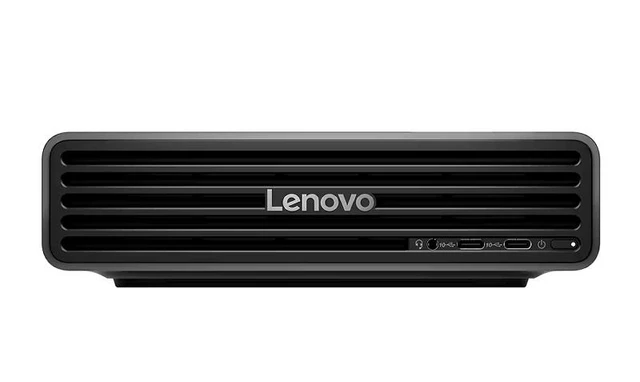
The modern workstation market is undergoing a fundamental paradigm shift: the focus is migrating from simple data processing toward the support of "agentic AI." We are talking about systems that do not merely answer queries, but are capable of autonomously planning tasks and managing complex workflows. In this context, the ThinkCentre X Ultra is not just another mini-PC; it is an attempt to reimagine the very concept of the desktop computer, transforming it into a modular building block for constructing a local supercomputer.
The architectural backbone of the device is the AMD Ryzen AI Max+ PRO 495 from the Gorgon Halo family. This solution integrates 16 high-performance Zen 5 cores with powerful Radeon 8065S integrated graphics featuring 40 compute units. However, the pivotal element here is the specialized Neural Processing Unit (NPU) delivering approximately 55 TOPS, which handles the computational overhead of AI acceleration, freeing the primary cores for critical system processes.
The approach to memory management deserves particular scrutiny. The use of up to 128 GB of unified LPDDR5X memory allows the system to bypass the "memory bottleneck" that plagues even the most expensive discrete GPUs. In traditional systems, VRAM is typically capped at 24 or 32 GB, making the local execution of large-scale models nearly impossible without cloud reliance. In the ThinkCentre X Ultra, up to 96 GB can be allocated directly to the graphics subsystem, enabling the local deployment of models that previously required enterprise-grade server hardware.
Lenovo's most provocative vision is the ability to link up to four such devices into a single compute cluster. In this configuration, the aggregate unified memory reaches a staggering 512 GB. This transforms a group of compact PCs into a powerhouse platform capable of processing ultra-long contexts and executing multi-agent orchestration, where several neural networks interact with one another in real time.
From an enterprise perspective, the device is equipped with the comprehensive ThinkShield security suite and DASH remote management tools. Integration with the AMD Ryzen AI Developer Center provides developers with turnkey tools and optimized workflows for both Windows and Linux, significantly lowering the barrier to entry for creating proprietary local AI services.
Despite the impressive specifications, certain technical nuances remain shrouded in ambiguity. Specifically, the exact mechanism of node clustering remains an open question. While the presence of two Thunderbolt 4 ports with 40 Gbps throughput and a 10GbE network interface suggests the use of high-speed data transfer protocols, the efficiency of memory and model distribution across physically separate devices will be the ultimate litmus test for this concept.
Rounding out the design is adaptive lighting that serves as a visual system status indicator, evolving a rigid corporate tool into a sophisticated, high-tech gadget. With pricing starting at $3,699 and shipments beginning in November 2026, the ThinkCentre X Ultra redefines the benchmark for professional workstations, where power is determined not by the size of the chassis, but by the flexibility of its scalability.
 Nvidia N1X and the New Era of Arm PCs