Wind remains one of the primary bottlenecks hindering the advancement of small-scale unmanned aerial vehicles (UAVs). Relying on the brute force of their motors, modern drones are often powerless against chaotic vertical gusts—atmospheric turbulence capable of radically shifting a wing's lift. Nature solved this challenge millions of years ago through the evolution of flawless adaptive mechanisms. Now, researchers from RMIT University and the University of Bristol are drawing inspiration from the Australian kestrel to redefine the fundamental principles of UAV stability.
For most modern drones, high winds necessitate an immediate landing. This is not merely a technical inconvenience, but a fundamental aerodynamic bottleneck. Vertical air currents are particularly perilous; depending on wing geometry, they can cause fluctuations in lift ranging from 25 to 100-fold. At the low altitudes where UAVs typically operate, such disturbances are ubiquitous, and global climatic shifts are only increasing the frequency and intensity of these turbulent phenomena.
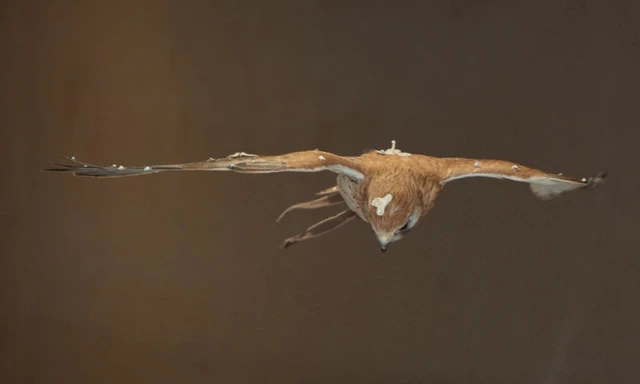
The solution to this challenge may lie in biomimicry—the integration of natural mechanisms into engineered systems. Researchers have turned their attention to the Australian kestrel, a bird capable of hovering almost motionless even amidst violent gusts of wind. Utilizing motion capture technology within a wind tunnel, scientists discovered that the bird's secret lies in an extraordinary level of control complexity. While a typical drone operates with only four degrees of freedom, the kestrel employs twenty-two.
Mass distribution plays a pivotal role. The bird's mass is centralized within its torso, minimizing inertia and allowing it to correct its flight trajectory nearly twice as fast as a drone of comparable size. Furthermore, the natural flexibility of its joints and feathers acts as a mechanical damping system, absorbing sudden atmospheric shocks before they can destabilize the bird's overall equilibrium.
To quantify these processes, engineers developed a high-fidelity robotic replica of the bird, designed using computed tomography (CT) data. Wind tunnel tests at speeds of 7 m/s revealed the critical importance of the synergistic interaction between the wings and the tail. When these elements operate in synchrony, the cumulative increase in lift is significantly higher than when they move independently. While the wings generate the necessary lift, the tail simultaneously counteracts parasitic rotation. Consequently, the bird resists the gust, maintaining absolute spatial stability. In contrast, a standard drone attempting to compensate for wind through motor power or chassis tilt inevitably loses stability and flips.
The kestrel's tail functions as a dynamic stability regulator. When fully spread, it effectively blocks any attempt by the wind to pitch the bird forward or backward. However, by tucking its tail, the bird enters a state of aerodynamic neutrality, maximizing its maneuverability. This ability to switch instantaneously between "rigid fixation" and "fluid maneuverability" represents a level of adaptability currently unattainable by any modern UAV.
Yet, the most difficult element to replicate is the sensory apparatus. The kestrel's feathers act as high-sensitivity sensors, detecting vibrations and flow separation points in real time, while receptors in the joints monitor structural loads. This creates a closed-loop feedback system with ultra-low latency.
Developing a drone that fully replicates these capabilities will be a formidable engineering challenge. The kestrel's stability is not the result of a single "secret" mechanism, but the outcome of a complex interplay between morphology, dynamics, and sensory integration. In the near future, researchers plan to focus on how birds anticipate wind gusts by reading subtle turbulence signals. The development of such predictive control systems could prove to be a breakthrough not only for small UAVs but for larger aircraft as well, ushering in a new era of resilient aviation.
 Driver Attention Monitoring in Tesla Electric Vehicles