The quest for extraterrestrial life demands a paradigm shift beyond the mere identification of planets within the "habitable zone." Unlocking the true potential of a distant world requires a granular analysis of its atmospheric dynamics and climatic cycles. To this end, researchers at Trinity College Dublin have pioneered a method to decode weather patterns on remote celestial bodies by analyzing infinitesimal fluctuations in their luminosity. This approach transforms raw telemetry from space-based observatories into a high-fidelity map of cloud formations and thermal shifts, streamlining the search for truly biotic worlds.
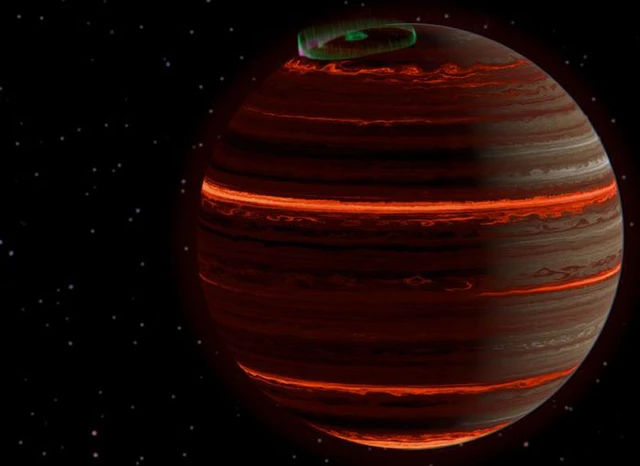
In contemporary astrophysics, brown dwarfs occupy a singular, liminal space. These objects are too massive to be classified as planets, yet they lack the density required to ignite sustained hydrogen fusion—the catalyst that transforms a celestial body into a true star. Consequently, they serve as ideal "laboratories" for studying atmospheric phenomena. Unlike the majority of exoplanets, which are detected indirectly (for instance, via the transit method), brown dwarfs can be observed directly, allowing for a detailed analysis of their gaseous envelopes.
One such object is SIMP 0136, situated approximately 20 light-years from Earth. Due to the high atmospheric temperature of this body, modern instrumentation—specifically the James Webb Space Telescope—is capable of capturing high-fidelity data regarding its atmospheric state. By monitoring the flux of light emanating from this distant point as it rotates, researchers have effectively gained the ability to track cloud migration and surface temperature gradients.
The primary challenge in analyzing such data is the overwhelming volume of noise coupled with the sheer complexity of the underlying physical processes. Rather than attempting to immediately construct a cumbersome physical model of the atmosphere, researchers employed Principal Component Analysis (PCA). At the heart of this statistical approach is dimensionality reduction: the algorithm decomposes a massive observation array into several independent components that explain the vast majority of the system's variability.
In the case of SIMP 0136, it emerged that the entire complexity of atmospheric processes boils down to two dominant components. The first parameter accounts for temperature fluctuations, while the second governs the vertical structure of the cloud cover. Thus, what initially appeared as a chaotic stream of data has been distilled into a coherent system, enabling the recognition of weather patterns across tens of light-years.
Based on these components, three recurring atmospheric states were identified, cycling as the object rotates. The telescope's field of view alternately captures hot regions with sparse cloud cover and colder regions where dense vertical cloud layers form. Notably, these structures remained discernible for more than ten rotations, despite the gradual evolution of the atmospheric formations themselves.
The application of PCA allowed researchers to strip away statistical noise and instrumental errors without requiring a priori assumptions about atmospheric structure or exhaustive numerical modeling. This establishes an efficient two-stage data processing pipeline: PCA first identifies the primary physical drivers of the system, which then serve as the foundation for complex models of heat transfer, chemical composition, and atmospheric dynamics.
Looking ahead, this methodology will be scaled to other brown dwarfs and massive exoplanets. Comparing the atmospheric dynamics of different worlds will allow astrophysicists to understand the boundaries of weather diversity across the universe. Ultimately, this filtering process will become a critical tool for pre-selecting candidates for "habitable worlds," ensuring that the costly resources of our observatories are directed toward objects that truly possess a climate conducive to the emergence of life.
 The Orbital Leap of the Starship System