The concept of the "Root of Trust" serves as the bedrock of modern cybersecurity, with the Trusted Platform Module (TPM) acting as the ultimate guarantor of system integrity. However, the discovery of critical vulnerabilities within this mechanism's implementation in AMD Ryzen processors casts serious doubt on the reliability of data isolation at its most fundamental level. When attestation keys and encryption frameworks are compromised, the risk of a total loss of control over protected content becomes an imminent reality. This situation underscores the inherent fragility of hardware-based security assurances in an era of hyper-complex microarchitectures.
The security of contemporary computing systems relies heavily on the Trusted Platform Module (TPM)—a specialized cryptoprocessor responsible for key storage, boot integrity verification, and device authentication. In AMD's Ryzen family, this functionality is often implemented via firmware-based TPM (fTPM), making it inherently dependent on the integrity of the firmware. The recent release of security bulletin AMD-SB-7064 has exposed critical flaws in this implementation that could be exploited to bypass fundamental security mechanisms.
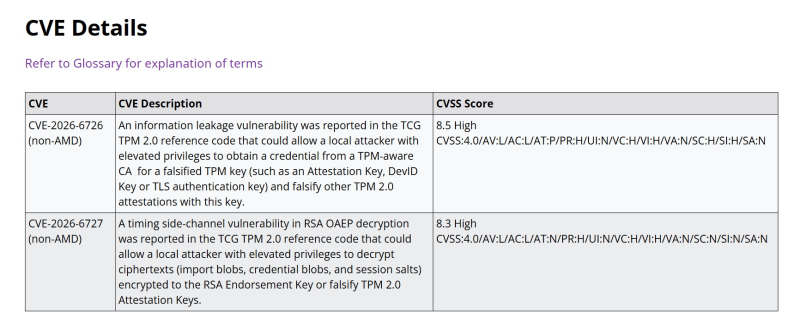
The technical crux of the issue centers on two vulnerabilities: CVE-2026-6726 and CVE-2026-6727. The former allows a local adversary with elevated privileges to obtain credentials necessary for generating a fraudulent TPM key. In practice, this enables the spoofing of system attestation; malicious software could deceive the operating system or external services into believing the execution environment remains pristine and secure, even while it is compromised.
The second vulnerability, CVE-2026-6727, is more sophisticated in nature. It involves a side-channel attack linked to RSA OAEP synchronization. In cryptography, such attacks rely on analyzing execution timing or processor power consumption to reconstruct secret data. In this instance, an attacker could extract encrypted TPM data or generate forged attestation keys, jeopardizing the confidentiality of stored passwords and biometric data.
The scale of the impact is significant, as these vulnerabilities affect nearly the entire modern product lineup. At-risk hardware includes Ryzen processors from the 3000 through 9000 series, including high-performance Threadripper solutions and specialized Ryzen Embedded lines. Furthermore, the latest Ryzen AI chips (300/400 and Max 300 series), as well as the Z1 and Z2 mobile platforms used in handheld gaming consoles, are also affected.
Remediation required urgent intervention at the AGESA microcode level—the fundamental processor initialization code integrated by motherboard manufacturers into BIOS updates. The patching process was deployed in stages: firmware ComboAM4PI 1.0.0.11 was released for legacy Ryzen 3000 systems, while versions 4000 and 5000 received ComboAM4v2PI 1.2.0.12. Owners of modern AM5 platforms (Ryzen 7000, 8000, and 9000) were provided with ComboAM5PI updates versions 1.3.0.1b and 1.2.0.3k.
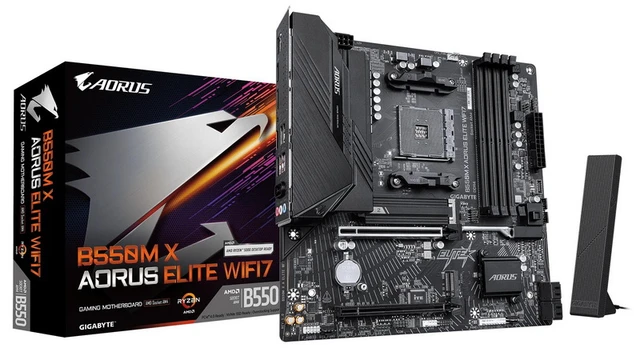
Leading motherboard vendors, including Asus, Gigabyte, MSI, and ASRock, began integrating these patches into their BIOS as early as May and June. For instance, Asus promptly released a series of updates for its premium X870-P WIFI boards, while MSI and ASRock systematically closed the gaps in models featuring B650, X670E, and A620 chipsets. Consequently, system security now rests entirely on user vigilance and timely firmware updates—reaffirming the premise that hardware security is never absolute and demands continuous maintenance.
 The Price of Acceleration: CXMT’s Rapid Push into Memory