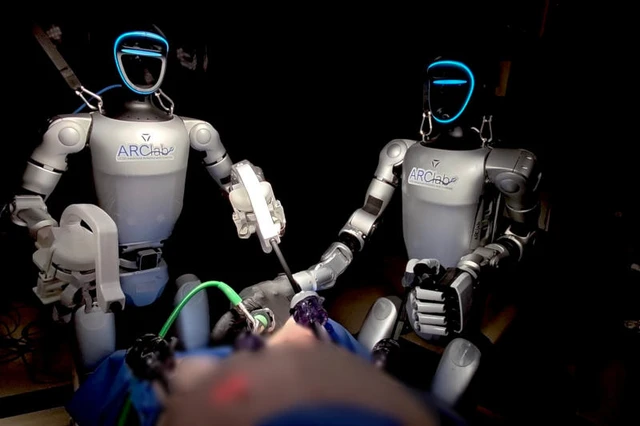
For years, cutting-edge medical technology has been the exclusive domain of premier healthcare institutions, gated by the exorbitant cost of specialized equipment. Yet, the advent of telesurgery promises to dismantle these geographical barriers, empowering world-class surgeons to operate on patients regardless of their location. Researchers at the University of California, San Diego, set out to test this premise by employing the Unitree G1—an accessible humanoid robotic platform—as their primary instrument. This experiment raises a pivotal question: are we on the verge of shifting away from cumbersome, specialized systems toward compact, versatile robotic platforms?
For years, Intuitive Surgical's da Vinci system has stood as the gold standard of robotic surgery. Yet, despite its efficacy, it is plagued by several critical shortcomings: a massive 800 kg footprint, cumbersome dimensions, and, most prohibitively, a price tag that can soar into the millions of dollars. This financial barrier effectively locks out small regional clinics and budget-constrained hospitals from accessing high-precision surgical care.
As a disruptive alternative, researchers have proposed the use of general-purpose humanoid robots. The spotlight has fallen on the Unitree G1—a compact android weighing just 27 kg and standing 1.5 meters tall. The economic disparity here is stark: even a G1 variant equipped with functional manipulators suited for medical tasks costs approximately $67,000. This is an order of magnitude cheaper than traditional surgical systems, paving the way for the democratization of high-tech medical intervention.
Transforming an industrial humanoid into a viable surgical assistant required overcoming several complex engineering hurdles. Since the Unitree G1 is not a medical device "off-the-shelf," the team developed specialized adapters to ensure the robots could securely grip surgical instrumentation. Simultaneously, they engineered software capable of translating a surgeon's intuitive hand movements into high-precision commands for the robot's actuators.
The control architecture was built on the principle of telepresence: the surgeon monitored the operative field via a stereoscopic display to ensure depth perception, while movement was managed via a foot pedal. In a series of experiments on live porcine models, the robots successfully performed cholecystectomies (gallbladder removals). While the first procedure was conducted with the support of a human assistant, the second was executed entirely by two robots.
However, the shift from specialized medical hardware to versatile androids revealed significant technical bottlenecks. A primary concern is the limited workspace of the Unitree G1's manipulators, which spans only 450 mm. By comparison, the human arm's range of motion reaches 1.6 to 1.8 meters, severely restricting the operator's maneuverability and necessitating frequent repositioning of the robot itself.
Furthermore, the experiment highlighted the critical issue of signal latency. In the remote control of the humanoid, latency was measured in hundreds of milliseconds, whereas safe surgical manipulation requires a threshold of under 150 ms. Coupled with the need for periodic system recalibration during surgery, these factors render the current iteration a promising prototype rather than a clinical-grade solution.
Nevertheless, the successful operation on living organisms validates the core concept. If data latency can be minimized and the manipulators' operational envelope expanded, the world could gain an affordable tool for telesurgery—one where a surgeon's expertise is no longer tethered to the physical location of a costly operating theater.
 The Expansion of Semiconductor Foundry Giants