Modern astronautics is entering an era of high-precision operations involving small celestial bodies—a domain where a single computational error can jeopardize an entire mission. China's Tianwen-2 probe, designed to collect samples from a near-Earth asteroid, encountered an unforeseen complication immediately upon arrival at its destination. The target object proved to be substantially smaller than preliminary models had predicted, transforming a routine scientific objective into a formidable technical challenge. Engineers must now recalibrate the rendezvous algorithms to accommodate a body that resembles a colossal space boulder more than a conventional asteroid.
The voyage to asteroid 2016 HO3, better known as Kamoʻoalewa, spanned approximately 400 days for the Tianwen-2 interplanetary station. During this transit, the spacecraft covered a distance of one billion kilometers, showcasing pinpoint navigational accuracy. The approach was executed in several calculated phases: from the initial target acquisition on June 6 to a systematic reduction in distance, closing the gap from 30,000 kilometers down to 2,000. By early July, the station reached a proximity of 20 kilometers, enabling the capture of the first high-resolution images and the commencement of a comprehensive analysis of the object.
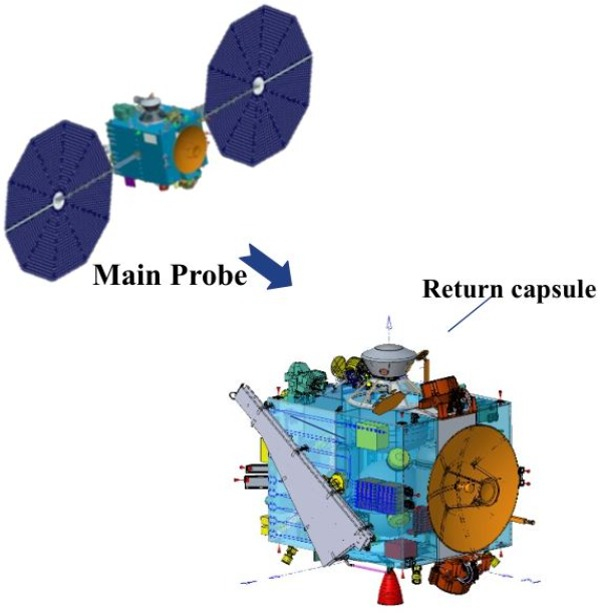
Launched in May 2025 from the Xichang Space Center, the mission is an ambitious, multi-phase endeavor with a ten-year strategic horizon. Tianwen-2 is engineered as a complex consisting of an orbital module and a return capsule, with a combined mass of roughly two tons. The station's scientific payload is formidable, featuring ten specialized instruments and one experimental module. Spectrometers, high-resolution cameras, and thermal radiation sensors are tasked with meticulously analyzing the celestial body's internal structure and chemical composition before the spacecraft embarks on its most precarious phase: the soil sampling.
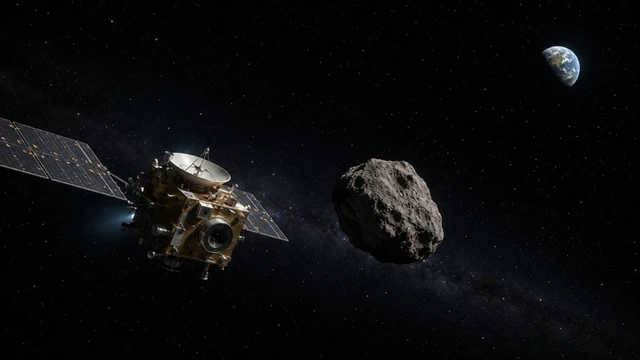
However, as the probe closed in on Kamoʻoalewa, scientists detected a critical divergence in the data. While previous estimates placed the asteroid's size between 40 and 100 meters, the actual dimensions proved far more modest—only 20 to 30 meters. In the context of interplanetary travel, such a discrepancy might seem negligible, but for automated landing systems, it fundamentally alters the operational calculus. For comparison, the Japanese Hayabusa2 and the American OSIRIS-REx missions targeted Ryugu and Bennu, objects measured in the hundreds of meters. With Kamoʻoalewa, the station is contending with a compact, rapidly rotating body, which radically complicates gravitational calculations and stabilization during contact.
The object's status adds another layer of complexity. Kamoʻoalewa is a quasi-satellite of Earth, orbiting the Sun nearly in lockstep with our planet. While this makes it accessible for a relatively rapid transit, it creates unique dynamic conditions. The asteroid rotates on its axis with a period of just 28.45 minutes. This high rotational velocity, combined with its small mass, generates centrifugal forces that could literally "repel" the probe during a touchdown attempt. Furthermore, the surface may be an inhomogeneous mixture of large boulders and loose regolith, rendering any landing attempt inherently perilous.
To mitigate these risks, the sampling strategy has been diversified. Rather than relying on a single scenario, Tianwen-2 will employ several interaction modes: ranging from simple hovering and brief "touch-and-go" maneuvers to full surface attachment. The selection of the specific method will depend on the data gathered during the current phase of topographic mapping and soil composition analysis.
The mission timeline remains aggressive: sampling must be completed by April 24, 2027, with the return capsule scheduled to reach Earth in December of that year. Yet, the mission's ambitions do not end there. After delivering the samples, the station will set course for its next target—the enigmatic comet 311P/PANSTARRS. Located beyond the orbit of Mars, this object is of particular interest to astronomers due to its ability to eject dust tails under conditions where such a phenomenon seems physically impossible. In this way, Tianwen-2 is evolving into a long-term instrument for studying the evolution of small solar system bodies, transitioning from "celestial rubble" to the complex icy structures of deep space.
 SpaceX’s Hundred-Billion Dollar Leap into Louisiana