The race for Low Earth Orbit (LEO) has evolved from a mere competition into a definitive display of absolute technological dominance. SpaceX has moved beyond simply launching satellites, effectively transforming space into a streamlined logistics hub. Records from the first half of 2026 confirm that the company is constructing infrastructure on a scale that remains utterly unattainable for its rivals. This is no longer just the rollout of a communication network; it is the full-scale industrialization of near-Earth space.
By 2026, the pace of Starlink's expansion has entered a phase that can only be described as industrial scaling. In the first six months of the year, SpaceX deployed 1,589 satellites into low Earth orbit (LEO), not only cementing its dominance but surpassing the benchmarks of the previous record-breaking year, 2025. During that period, 1,489 units had been deployed by June, with a final annual total of 3,180. Current dynamics indicate that SpaceX is increasing its launch cadence year-over-year, creating a gap between itself and its competitors that is becoming virtually insurmountable.
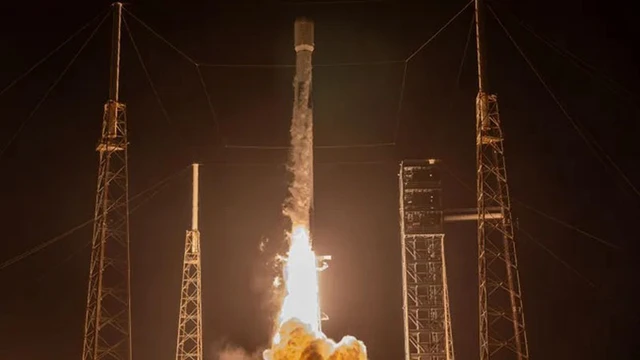
The foundation of this success lies in the unprecedented utilization of reusable systems. A prime example is the recent launch on July 9, 2026, from the U.S. Space Force Station at Cape Canaveral. In this mission, the Falcon 9 first stage (Booster 1067) was flown for the 36th time. For the aerospace industry, this level of durability and reliability is phenomenal. This specific booster has become a veteran of orbital missions, having facilitated cargo deliveries under the CRS-22 program, transported crews for Crew-3 and Crew-4, and deployed heavy commercial satellites such as Turksat 5B and O3B mPOWER.
The technological cycle of the mission has evolved into a finely tuned machine: 8.5 minutes after liftoff, the first stage performed a precision landing on the autonomous drone ship A Shortfall of Gravitas in the Atlantic Ocean, while the second stage deployed another batch of 29 Starlink satellites an hour later. This operational model—combining an ultra-rapid booster turnaround with the mass deployment of standardized spacecraft—has effectively turned the Falcon 9 into an orbital assembly line. 2026 statistics confirm this trend, with approximately 80% of all Falcon 9 launches dedicated to replenishing the Starlink constellation.
On a global scale, Starlink has evolved into the largest satellite network in human history. The total number of launched spacecraft has exceeded 12,400, with nearly 11,000 remaining fully operational. This density of coverage ensures minimal signal latency and global internet availability, transforming the network into a strategic asset within the modern digital economy.
Against this backdrop, Amazon's Project Kuiper appears more like a cautious experiment than a viable competitive threat. In 15 months of operation, the company has deployed only about 400 satellites, while its target constellation requires 3,232 units. Comparative analysis reveals that at its current pace, SpaceX could deploy a network of Amazon's target scale in just a single year. This disparity in deployment speed underscores the critical importance of owning a proprietary reusable launch system, which radically reduces the cost of delivering every kilogram of payload to orbit.
 SpaceX’s Hundred-Billion Dollar Leap into Louisiana