The race for cosmic supremacy has shifted from a pursuit of technological prestige to a realm of staggering financial stakes. Blue Origin, long maintained as Jeff Bezos's private venture, has opened its doors to external investors for the first time. This pivot signals a strategic shift and an aggressive drive toward scaling amidst intensifying competition. A valuation of $130 billion underscores the founder's ambition to transform his aerospace enterprise into a new global empire.
Since its inception in 2000, Blue Origin has operated essentially as a private proving ground for Jeff Bezos's vision. For two decades, the company relied exclusively on internal resources and the personal fortune of its founder, who systematically liquidated his Amazon holdings to fuel his celestial ambitions. However, the current stage of industry evolution has necessitated a shift in financial paradigm: pivoting toward external capital has become a prerequisite for accelerating the pace of expansion.
The inaugural external funding round, totaling $10 billion, did more than just provide a surge of liquidity; it pegged the company's valuation at $130 billion. The structure of the deal underscores Bezos's determination to maintain tight control over the enterprise's strategic trajectory. Of the total investment, the founder contributed $2 billion, while $4 billion came from the hedge fund Coatue Management, with the remainder distributed among other external players.
Against this backdrop, a comparison with its primary rival—Elon Musk's SpaceX—is inevitable. While Blue Origin is only now embarking on a path of open investment, SpaceX has already constructed a sophisticated ecosystem where Starlink serves as the primary revenue engine and chief profit generator. Although both companies strive for dominance in heavy-lift launch vehicles and space colonization, their business models diverge significantly: SpaceX bets on vertical integration and the rapid commercialization of satellite internet, whereas Blue Origin has long operated in a deep R&D cycle, focusing on long-term infrastructure.
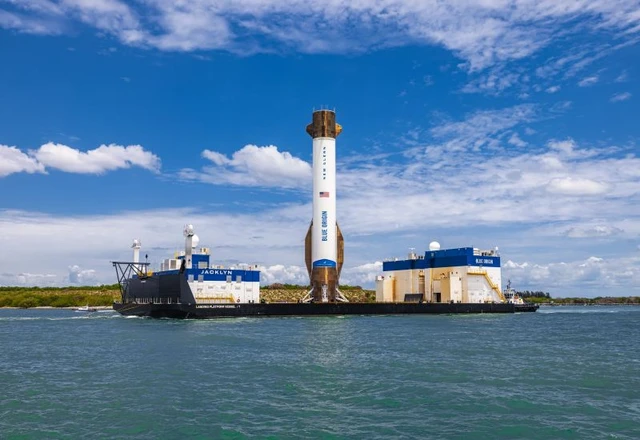
Yet, the road to success is fraught with severe technical setbacks. In May of this year, Blue Origin suffered a devastating blow: the explosion of a New Glenn rocket on the Florida launch pad. The incident resulted not only in significant material loss but also dealt a serious blow to the company's reputation. In an industry where reliability is the ultimate currency, such failures exert immense pressure on both the engineering teams and executive leadership.
Nevertheless, the company shows no sign of decelerating. Blue Origin intends to fully rectify the causes of the accident and return New Glenn to flight status by the end of the year. For Bezos, this project is a cornerstone of his global strategy. The founder has repeatedly asserted that, in the long run, Blue Origin could surpass even Amazon in scale and significance, evolving from an ambitious startup into the bedrock of a nascent space economy.
 The Foldable iPhone and the Transformation of the Mobile Market