The space industry is undergoing a fundamental paradigm shift in orbital payload logistics. The most recent Starlink deployment from Cape Canaveral signals the closing of a definitive chapter in SpaceX's trajectory—an era defined by the dominance of the Falcon 9. The strategic focus has now pivoted toward Starship, engineered to enable the deployment of satellite constellations on an unprecedented scale. This transition represents an evolution from iterative reusability toward the full industrial scalability of spaceflight.
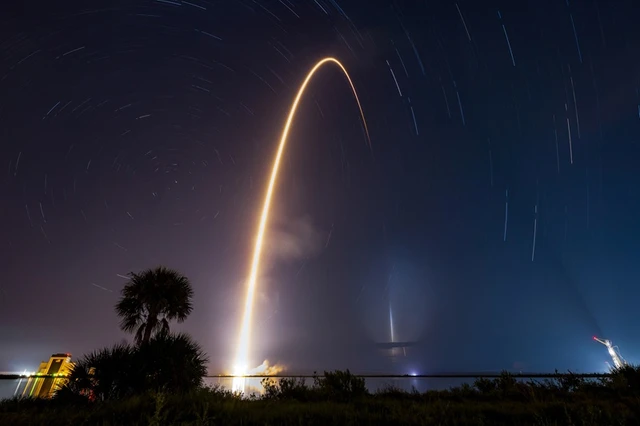
August 2026 marked a symbolic inflection point for SpaceX. The 100th Falcon 9 launch of the year, conducted from Space Launch Complex 40, served as the final act for Starlink missions at Cape Canaveral. This strategic Florida hub is now pivoting entirely toward supporting Starship—a system designed to radically redefine the economics of space access.
From a technical standpoint, the launch underscored the remarkable durability and efficiency of the company's current fleet. The rocket, which deployed 29 Starlink satellites, utilized first-stage booster B1067. This specific module completed its 37th flight since entering service in June 2021, setting a new internal record for reusability. Such a level of component resilience transforms the rocket from a costly expendable into a fully realized operational asset.
The mission culminated in an impeccable touchdown of the first stage on the autonomous drone ship A Shortfall of Gravitas in the Atlantic Ocean. This maneuver marked the 165th landing for this specific platform and the 654th in SpaceX's overall history, confirming that the once-daunting engineering challenge of vertical recovery has evolved into a standard operating procedure.
Yet, beneath this technical success lies a profound strategic pivot. SpaceX is bifurcating its operational pipelines: Vandenberg Space Force Base on California's West Coast will continue to handle Starlink missions via Falcon 9. Meanwhile, Florida's infrastructure is being cleared to prepare for the mass deployment of Starship, for which new launch complexes are currently under aggressive construction.
The company's ambitions extend far beyond existing launch sites. Plans to establish a new Starbase in Louisiana next year signal a drive toward creating a true "spaceport." Projections suggest such infrastructure could enable thousands of Starship launches annually, effectively blurring the distinction between aviation and space travel.
The scale of the Starlink mega-constellation deployment over recent years has placed immense pressure on production and launch cadences. The statistics are striking: in 2024 and 2025, the company executed 297 missions, the vast majority of which—211 launches—were dedicated to Starlink. This momentum has persisted into 2026; of the 100 Falcon 9 flights completed thus far, 77 were directed toward the satellite network. This intensive rhythm has served as the perfect proving ground for reusability technologies, which now allow SpaceX to transition to its next, far more massive phase of expansion.
 SpaceX’s Hundred-Billion Dollar Leap into Louisiana