The global mobile device market is undergoing a fundamental metamorphosis, as utilitarian pragmatism gives way to an appetite for uncompromising quality. The premium segment is experiencing unprecedented growth, emerging as the primary engine driving the entire smartphone industry. At the heart of this evolution remains Apple; its mastery in monetizing both brand prestige and technological superiority has enabled it to maintain a commanding grip on the market. This trend reflects more than just evolving consumer habits—it signals profound economic shifts within the very fabric of modern electronics manufacturing.
The contemporary smartphone landscape is witnessing a distinct trend toward "premiumization." According to recent data from Counterpoint Research, by the end of the first half of 2026, high-end devices accounted for a record 29% of total global sales. This indicates that nearly one-third of consumers are now willing to pay a premium for flagship capabilities—a four-percentage-point increase over the previous year.
In this quest for prestige and performance, Apple continues to dominate, commanding 65% of the premium segment. While this is slightly below its 2022 peak of 74%, current dynamics suggest a return to robust growth. A 9% surge in sales volume was driven largely by the success of the iPhone 17 lineup, where the base model proved particularly resonant. This momentum has allowed the company to offset previous headwinds caused by fierce competition and demand volatility within the Chinese market.
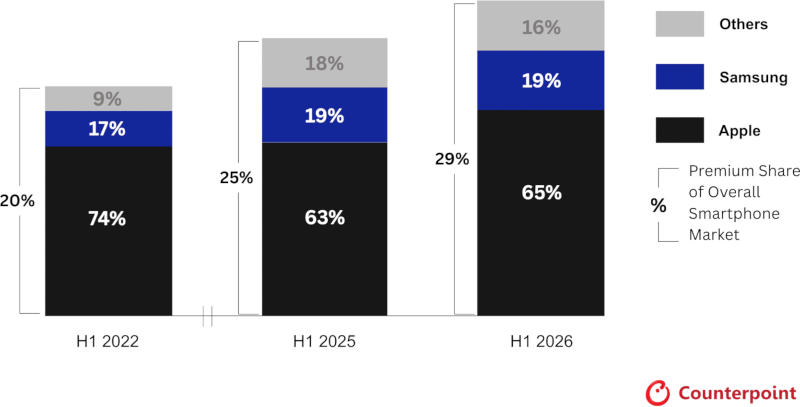
Samsung, holding the second position, demonstrates stability but has struggled to close the gap with the leader. The South Korean giant’s share of the premium class has plateaued at 19%, marginally higher than figures from two years ago. It is evident that the battle for the user is no longer fought solely on the battlefield of technical specifications, but increasingly in the realm of financial accessibility for high-end devices.
The drivers behind this market shift lie in the economics of manufacturing. Rising costs for memory and other critical components are forcing manufacturers to hike prices for mid-range devices. Consequently, the price delta between a "mid-tier" smartphone and a flagship—particularly when considering discounted models from previous seasons—is shrinking. Faced with a negligible price difference, consumers naturally gravitate toward higher-tier hardware.
To solidify this trend, brands are aggressively deploying demand-stimulation tools. Buyback and trade-in programs have become standard levers of influence; for instance, Samsung is scaling its Galaxy Forever program into new regions to lower the psychological and financial barriers to flagship ownership. Coupled with stabilized component supply chains and the evolution of consumer financing, this process is transforming the premium segment from a niche offering into the primary growth vector for the entire industry.
 The Evolution of Apple's Augmented Reality Ecosystem