The era of expendable launch vehicles—where the cost of space access was dictated by the price of discarded hardware—is definitively drawing to a close. SpaceX continues to fundamentally reshape orbital logistics, evolving heavy-lift launches from high-stakes events into routine, high-efficiency operations. Surpassing the milestone of 600 successful reuses of Falcon 9 first stages serves as a hallmark of this new industrial epoch. This achievement is more than a mere technical record; it is the bedrock upon which the rapid deployment of global satellite constellations is being built.
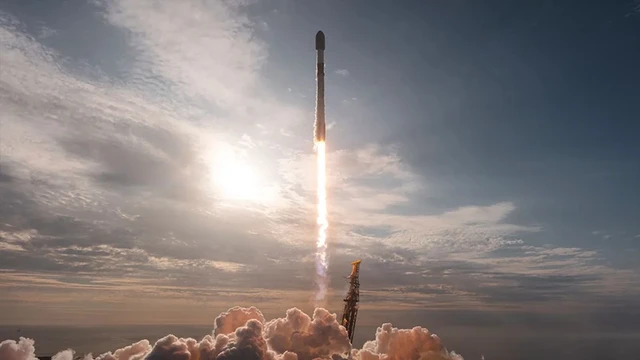
The events of the past 24 hours have vividly demonstrated SpaceX's operational maturity: the company executed two Falcon 9 launches within a mere eight-hour window, utilizing separate launch sites. The first lift-off occurred from Space Force Base Vandenberg’s Complex 4 East in California, deploying another batch of 27 Starlink satellites. Just hours later, a similar mission was carried out from SLC-40 at Cape Canaveral in Florida, delivering an additional 27 communication satellites.
This launch cadence is made possible by the refined technology of vertical landings and subsequent stage refurbishment. These missions utilized boosters with significant flight pedigrees: rocket B1093 completed its 15th flight, while B1080 successfully executed its 28th mission. Notably, the current absolute record for re-flights of a single stage stands at 36 cycles—a testament to the immense structural integrity and material reliability engineered into the Falcon 9.
This technological cycle directly fuels the expansion of the Starlink constellation. According to astrophysicist Jonathan McDowell, the total number of active broadband relay satellites has now reached 10,839 units. Scaling a network of this magnitude would be economically untenable under traditional rocketry paradigms, as the cost of producing a new stage for every launch would have been catastrophic for the project's budget.
This year's trajectory underscores the company's dominant position in the commercial launch sector: with 83 Falcon 9 launches since the start of the year, space transport has effectively become a conveyor-belt system. SpaceX has established a new paradigm where the rocket is no longer a consumable but a reusable asset, radically lowering the barrier to entry for deploying large-scale orbital infrastructure.
 A Pragmatic Approach to Lunar Equipment Design