The wearables industry is undergoing a fundamental transformation, evolving from a collection of peripheral accessories into a comprehensive ecosystem for personal health monitoring. By 2032, the total market valuation is projected to breach the psychological threshold of one trillion dollars, signaling the profound integration of these technologies into the fabric of daily life. The primary catalyst for this growth is a strategic pivot: moving beyond basic activity tracking toward preventive medicine and deep AI integration. At the heart of this evolution are devices capable of diagnosing health anomalies well before the first clinical symptoms even manifest.
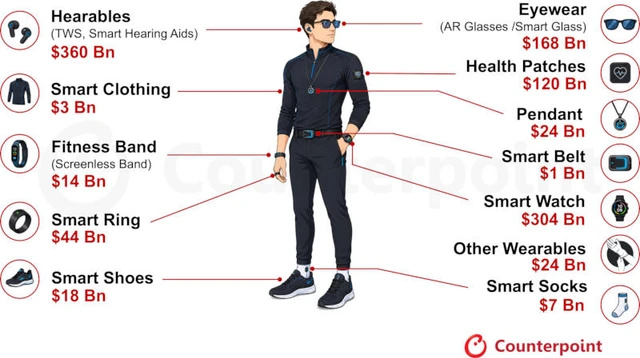
The contemporary wearables market is evolving beyond its origins as a niche for fitness enthusiasts, transforming into a global economic phenomenon. According to analytical data from Counterpoint Research, total industry revenue is projected to surpass $1 trillion by 2032. Notably, revenue growth is significantly outpacing shipment volumes, signaling a qualitative shift in consumer behavior: users are increasingly willing to pay a premium for more sophisticated, intelligent, and feature-rich solutions.
Wireless earbuds and smartwatches continue to dominate this hierarchy. The audio segment is forecasted to generate the highest revenue—approximately $360 billion. However, this market is showing signs of maturity; TWS earbuds are experiencing commoditization, where standardized feature sets and aggressive price competition are capping the growth of average unit prices.
Meanwhile, smartwatches—with an expected market volume of $304 billion—are evolving into full-fledged personal computing platforms. Here, the dynamics are different: the integration of advanced biometric sensors and AI algorithms is allowing manufacturers to drive up the average transaction value. The smartwatch is transcending its role as a mere wrist-worn notification hub, becoming a tool for preventative medicine capable of real-time, continuous health monitoring.
Smart glasses represent the third most significant vertical, with a potential valuation of $168 billion. This segment is the most promising growth vector, as it marks the convergence of augmented reality (AR) and everyday information interaction.
Beyond the tech giants, the market is being shaped by a diverse array of specialized devices. Medical patches, valued at $120 billion, are particularly noteworthy. Unlike traditional trackers, these devices operate at the intersection of electronics and biochemistry, providing high-precision health monitoring.
Following this is a hierarchy of narrower but rapidly growing categories:
- Smart rings — $44 billion;
- Smart pendants — $24 billion;
- Smart footwear — $18 billion;
- Fitness trackers — $14 billion.
Rounding out the list are innovative developments in "smart textiles"—clothing, socks, and belts with integrated sensors, each potentially contributing up to $10 billion to the industry.
The overarching global trend indicates a gradual pivot from "fitness tracking" toward proactive healthcare. The technological stack is shifting toward predictive analytics, where devices no longer simply record a deviation in metrics but identify pathologies at their inception. Consequently, wearables are becoming the primary and most critical line of diagnostics, seamlessly integrated into the ecosystem of smartphones and cloud-based healthcare services.
 The Evolution of Apple's Augmented Reality Ecosystem