Compact gaming systems are perpetually plagued by a fundamental tension: the drive for high-performance components versus the physical constraints of thermal dissipation. In the pursuit of minimalism, manufacturers often compromise thermal headroom—a trade-off that inevitably leads to thermal throttling and diminished system stability. The solution lies in a radical pivot toward bespoke liquid cooling loops. This engineering experiment featuring a Steam Machine demonstrates the potential for extreme thermal management within an uncompromisingly tight footprint.
Contemporary mini-PCs, packed with high-performance silicon, present a formidable thermodynamic puzzle. When a Zen 4-based six-core processor and an RDNA 3 GPU with 8GB of VRAM are crammed into a restricted chassis, traditional cooling solutions often buckle under the sheer density of the heat flux. In such scenarios, achieving optimal thermal performance requires a fundamental paradigm shift: moving away from conventional air cooling toward custom liquid loops.
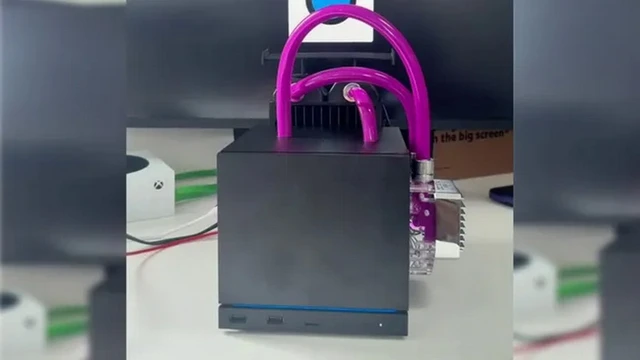
The overhaul of this Steam Machine evolved into a comprehensive engineering undertaking, beginning with high-precision 3D scanning of the motherboard. This allowed for the creation of a detailed digital model of a unified water block designed to simultaneously dissipate heat from both the CPU and GPU. The technical execution demanded precision machining: the base of the block was CNC-milled from copper to ensure maximum thermal conductivity, while the top was crafted from heavy-duty acrylic to allow for visual monitoring of the coolant flow.
Integrating the system into such a compact chassis necessitated structural modifications—specifically, apertures were cut into the top cover to accommodate the flexible tubing. To preserve central space, the loop's core components, including the pump and radiator, were strategically positioned along the sides of the device. A supplementary fan array was implemented to finalize the heat rejection process and close the cooling cycle.
From a thermometric perspective, the results were striking: core temperatures plummeted by 20–30 degrees Celsius. However, this reveals a critical technical nuance of modern systems. Despite the massive thermal headroom, the actual performance gains in titles like Cyberpunk 2077 remained marginal. This is because power limits are dictated not only by cooling capacity but also by the BIOS firmware, which strictly caps power consumption and precludes overclocking.
Ultimately, the project stands as a triumph of engineering ingenuity and aesthetics rather than a quest for higher frame rates. It serves as a compelling demonstration that even within the most restrictive form factors, benchmark thermal performance is achievable through custom design and industrial-grade material processing.
 The Price of Acceleration: CXMT’s Rapid Push into Memory