Market dynamics within the high-performance processor segment are seldom stagnant; however, stealthy price adjustments always serve as a telling indicator. In a bid to refine the positioning of its latest offerings, Intel has quietly revised the MSRP for several chips in the Core Ultra 200S Plus series. These adjustments specifically target unlocked models—the traditional domain of enthusiasts and overclockers. Such a move highlights the disconnect between the company's official rhetoric and the cold realities of market mechanics.
The silence surrounding Intel's pricing strategy was finally broken, thanks to the vigilance of the community. An update to the Intel ARK database—typically the gold standard for hardware pricing—revealed a significant revision of the Manufacturer's Suggested Retail Prices (MSRP) for several members of the Arrow Lake Refresh family. Rather than issuing official press releases, the company opted for a "stealth update," quietly implementing the new price points.
The most striking correction involves the Core Ultra 7 270K Plus. While the processor was initially positioned at $299 during its announcement, its recommended range has now shifted to between $339 and $349. A similar trend is evident in the more accessible segment: the Core Ultra 5 250K Plus has seen its starting price climb from $199 to a range of $219–$229.
This pricing shift suggests an attempt by the manufacturer to more accurately align official expectations with actual market demand. In the semiconductor industry, such maneuvers are common when a company realizes that the initial price was undervalued relative to the product's utility or when production costs exceed original forecasts.
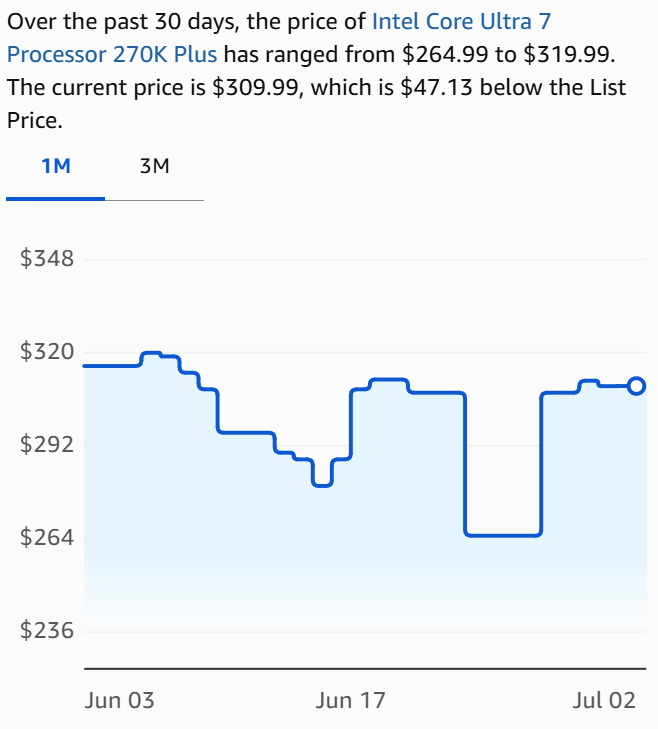
However, retail inertia creates a time gap between the update of Intel's database and the actual price tags on store shelves. Looking at Amazon, the largest US marketplace, prices remain volatile. The Core Ultra 7 270K Plus is currently listed at $309.99—still below the new official threshold, though just a week ago, the chip was available for $265 during promotional offers. Conversely, the Core Ultra 5 250K Plus settled almost immediately at $219.99, effectively matching the new recommended minimum.
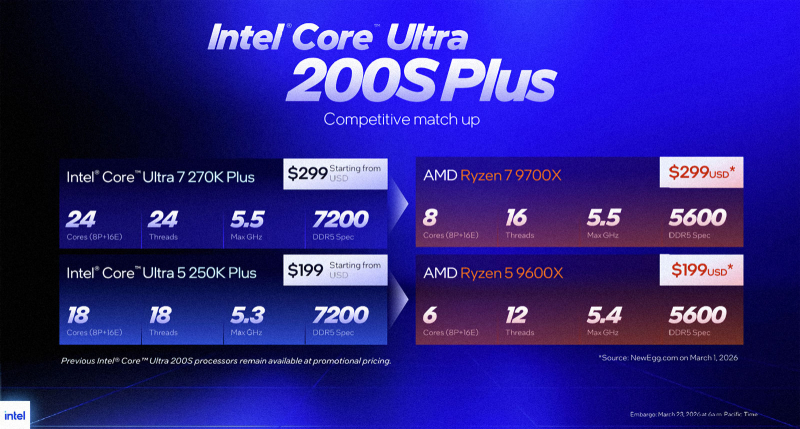
Analysis suggests that Intel's "suggested price" was initially more symbolic than binding. Since the launch, the actual market has dictated the terms: the Core Ultra 7 270K Plus vanished from shelves almost instantly at $299, with subsequent listings remaining consistently higher. Consequently, the current MSRP revision is less a sudden pivot and more a formal recognition of a market reality where demand for high-performance solutions with unlocked multipliers allows Intel to command a higher premium.
 The Dawn of the 2nm Era in the New iMac