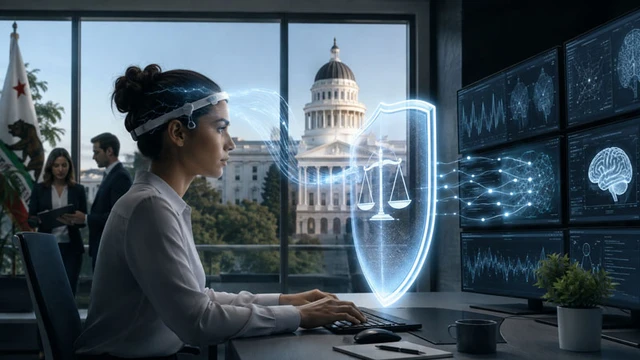
The boundary between human consciousness and digital data is becoming disturbingly porous. As neural interfaces migrate from sterile laboratories into the consumer market, the threat of corporate surveillance is descending to a biological level. California is now racing to establish a regulatory firewall around brain privacy before "mind reading" evolves into a standard tool for HR departments. This precedent marks the dawn of a global struggle for individual cognitive autonomy.
The world is standing on the precipice of an era where the electrical activity of the brain and the peripheral nervous system is being transformed into just another stream of personal data. We are no longer talking exclusively about futuristic implants or complex brain-computer interfaces (BCIs). Today, signals from our nervous system can be captured by ordinary headphones, specialized headbands, wristbands, and augmented reality headsets. This biometric information has the potential to reveal the deepest layers of a person's internal state, creating a dangerous precedent for how such data might be leveraged within employment relationships.
The technical architecture of this process relies on electroencephalography (EEG) and the analysis of biosignatures. Machine learning algorithms are now capable of isolating patterns of attention, signs of fatigue, or markers of stress from faint electrical impulses. In medicine, these tools are revolutionary, enabling paralyzed individuals to control technology or synthesize speech. However, in a corporate environment, those same technologies could morph into instruments of omnipresent surveillance, where an employee's emotional state becomes an object of constant monitoring and analysis.
Seeking to avoid the pitfalls of the past—where AI development outpaced legal frameworks, leading to unjustified terminations—California legislators are proposing stringent restrictions via bill AB 1883. This legislation targets worker surveillance systems, ranging from traditional cameras and geolocation to advanced neural sensors. The primary objective is to curb the practice of recognizing or predicting the emotional states of employees. The collection of neural activity data is slated for prohibition, with exceptions granted only for critical sectors such as aviation, aerospace, and defense programs, where monitoring an operator's state is a matter of physical safety.
Under this law, "neural data" is defined as any information obtained through the direct measurement of the central or peripheral nervous system. Crucially, the legislation does not restrict an employer's ability to evaluate employee behavior using traditional methods; rather, it targets biological intrusion. Violations of these norms could result in significant fines and damages lawsuits, creating a tangible economic risk for companies prone to excessive surveillance.
Parallel to this, a legal framework is evolving to protect neural data from commercial exploitation. Bill AB 1542 aims to block third-party access to information regarding human neural activity. This follows the previously enacted SB 1223, which officially classified neural data as "hypersensitive information," placing it in the same category as genetic code and private correspondence.
The problem is exacerbated by a striking degree of negligence regarding privacy within the consumer neurotechnology industry. A study by the Neurorights Foundation revealed that most manufacturers of neural devices either explicitly allow the transfer of data to third parties or employ ambiguous language in their privacy policies. Furthermore, only a small fraction of companies even mention the term "neural data" in their documentation, effectively leaving users defenseless against data brokers.
It is important to understand that regulators are not concerned with the fantastical notion of literal "mind reading," but rather with the exponential growth in the precision of AI-driven signal decoding. Modern platforms can already assess cognitive load and fatigue, while experimental systems are capable of reconstructing a user's intentions based on brain activity. Consequently, a sensor originally designed to prevent a driver from falling asleep at the wheel could stealthily evolve into a tool for assessing an employee's psychological fitness or productivity.
By 2027, this surveillance framework will be augmented by requirements from the California Privacy Protection Agency (CPPA) regarding automated decision-making systems. This will create an additional filter for AI algorithms that influence careers and employment. California is essentially attempting to establish the rules of engagement before human brain signals become as commodified as browser histories or social media behavioral profiles.
Naturally, the corporate sector is resisting these innovations. There is a legitimate concern that tech giants, armed with colossal resources, may find ways to bypass these restrictions—utilizing neural data for internal needs and product development, thereby creating regulatory gray areas in the realm of cognitive privacy.
 The Price of Acceleration: CXMT’s Rapid Push into Memory