The geopolitical rivalry between the U.S. and China is entering a phase of technological protectionism, with the robotics sector now squarely in the crosshairs. U.S. lawmakers are weighing a comprehensive ban on the import of Chinese robotics—a move that threatens to destabilize global supply chains. Yet, a granular analysis of market metrics suggests that such a maneuver may be less detrimental to Beijing than initially presumed. The global distribution of demand, coupled with the unique dynamics of the consumer segment, provides a significant buffer against external pressures.
Efforts to curb the expansion of Chinese robotics in the US are colliding with the stark realities of market economics. Analysts at IDC highlight a critical nuance: any potential ban is likely to target only new models. Devices already present in the market would remain available, with their capabilities expanding via software updates. However, this presents a significant strategic challenge for Chinese vendors. Their business model traditionally relies on rapid product iteration and fast generational turnover. Under a sanctions regime, this strategy becomes untenable, forcing manufacturers to radically rethink product lifecycles specifically for the American region.
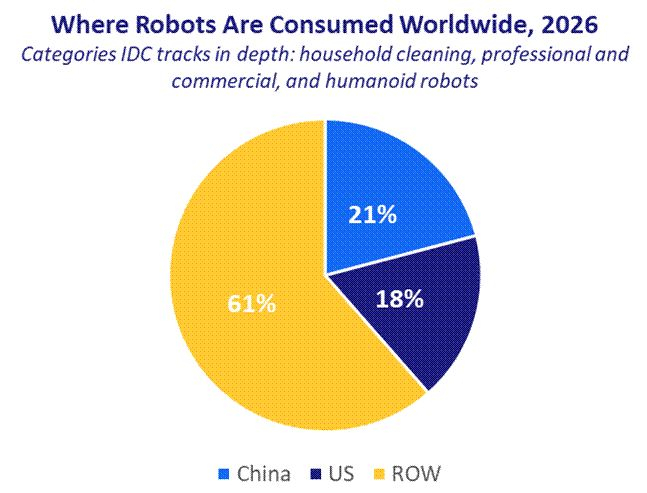
The geopolitical landscape also tilts in China's favor. The US accounts for only 18% of global robotics consumption, while China's domestic market stands at 21%. The most significant portion of demand—approximately 61%—is concentrated outside these two superpowers. Europe plays a pivotal role here, with consumption levels double those of the US. Consequently, a partial closure of the US market would not be catastrophic; Chinese suppliers can simply pivot their export flows toward the European continent, which is economically more attractive than the saturated and hyper-competitive domestic market within the PRC.
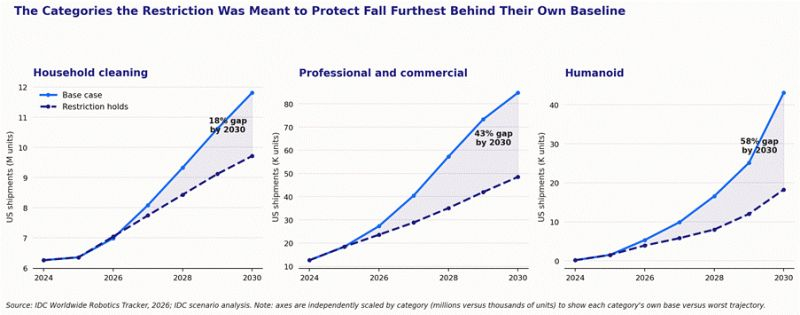
Even under the most stringent scenario, the US robotics market is expected to continue growing through 2030, albeit at a decelerated pace. The projected compound annual growth rate (CAGR) could slip from an optimistic 13% to a more conservative 9%. In monetary terms, revenue losses for the US could reach $6 billion by 2030, with the primary impact felt toward the end of the decade.
However, the severity of these sanctions will vary significantly across technological segments. The consumer sector—comprising robotic vacuums and similar devices—will prove the most resilient, with shipment volumes projected to drop by only 18% by 2030. The situation is more precarious in the industrial and commercial sectors, where losses could reach 43%. The most severe impact will hit the humanoid robotics segment, where shipments are forecasted to plummet by 58%.
The dilemma for the American consumer is that domestic US developments in humanoid robotics are not expected to reach mass-market scale until late 2028. Until then, a technological vacuum will emerge—one that will be exceptionally difficult to fill, given that Chinese companies currently control 82% of the global market for humanoid systems.
In the long run, economic pragmatism will dictate production terms. Onshoring robotics production in the US or Europe may be justified by national security requirements, but not by financial gain. Manufacturing in China remains significantly more cost-effective due to its sophisticated infrastructure and supplier ecosystem. While government subsidies might help establish local production for complex industrial or anthropomorphic systems, such a practice is virtually impossible in the consumer robotics segment. This implies that even amidst trade wars, the world will continue to receive massive shipments of consumer robots engineered in China.
 The Evolution of Apple's Augmented Reality Ecosystem