The quest for visual perfection in modern gaming is increasingly shifting toward the realm of intelligent algorithms. With the launch of FSR 4.1, AMD has presented RDNA 3 GPU owners with a new equilibrium between performance and visual fidelity. While the pivot to AI-driven upscaling yields a tangible leap in image quality, it necessitates certain performance trade-offs. This shift marks a pivotal milestone in the evolution of scaling technologies.
Modern gaming has evolved far beyond the mere pursuit of higher clock speeds. Today, the primary battleground is intelligent rendering, where upscalers dictate the critical balance between visual clarity and high frame rates. The latest Adrenalin 26.6.2 driver update introduces FSR 4.1 to the Radeon RX 7000 ecosystem—a technology that radically shifts the approach to image processing by leveraging the power of artificial intelligence.
The technical architecture of FSR 4.1 varies significantly across hardware generations. In the Radeon RX 9000 series (RDNA 4), the algorithms utilize the FP8 format, ensuring high computational precision. However, for the previous RDNA 3 generation, a different strategy was required: here, AI upscaling relies on INT8 computations. Utilizing integer-based arithmetic instead of floating-point allows the technology to leverage the existing resources of older cards, though it places a heavier burden on overall performance.
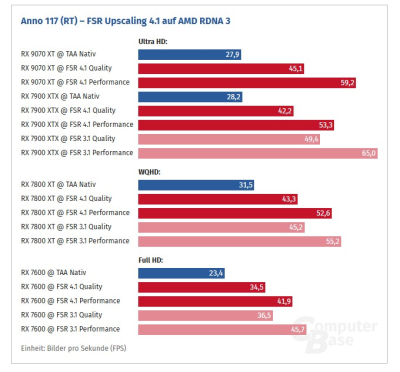
A comparison between FSR 4.1 and its predecessor, version 3.1, reveals a classic engineering trade-off: a substantial leap in image quality is achieved at the expense of frames per second. While early leaked iterations of the algorithm were plagued by visual artifacts, the final release delivers impressive image purity. Visual noise has been drastically reduced and object detail has become more stable, resulting in a more immersive gaming experience.
This aesthetic refinement, however, comes at a cost. Benchmarks on the flagship Radeon RX 7900 XTX at 4K resolution indicate that FSR 4.1 operates more slowly than its predecessor. In "Quality" mode, the performance uplift was 40%, compared to 57% with FSR 3.1; in "Performance" mode, the disparity widened further: 73% versus 103%. Ultimately, FSR 4.1 proves to be 11–14% slower than the previous iteration.
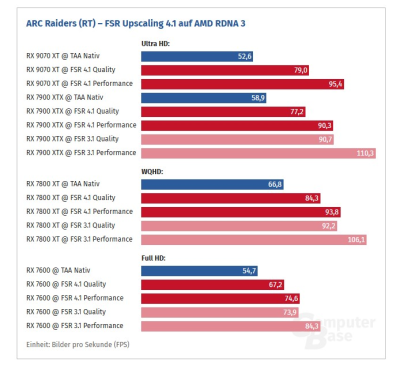
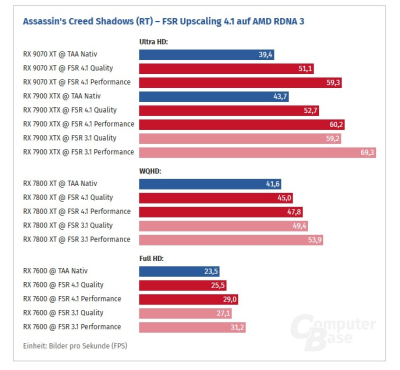
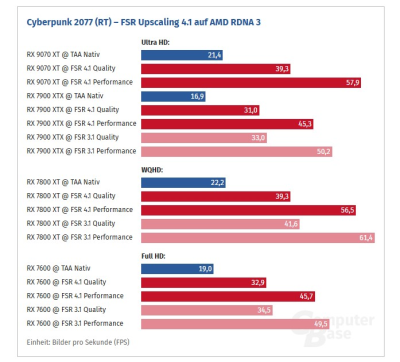
Interestingly, the degree of this performance dip correlates with the raw compute power of the GPU. On mid-range and entry-level cards, such as the Radeon RX 7800 XT (at 1440p) and the Radeon RX 7600 (at 1080p), the performance drop is less pronounced. Here, the difference between versions 3.1 and 4.1 is only 7% in "Quality" mode and 9% in "Performance" mode. This suggests that INT8 algorithms scale more efficiently on the less powerful RDNA 3 solutions.
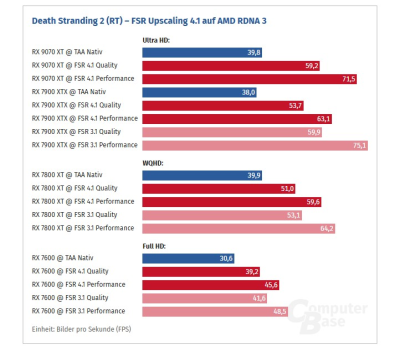
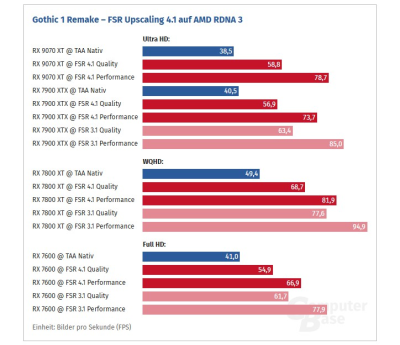
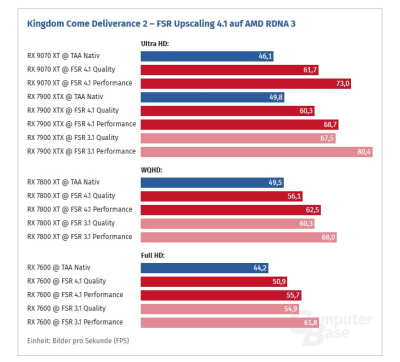
Analyzing the data, it becomes clear that FSR 4.1 pivots the focus from raw quantitative metrics to qualitative excellence. The most telling comparison lies in the profiles: the "Balanced" setting in FSR 4.1 is nearly indistinguishable in speed from the "Quality" mode in FSR 3.1, yet it delivers a visually superior image.
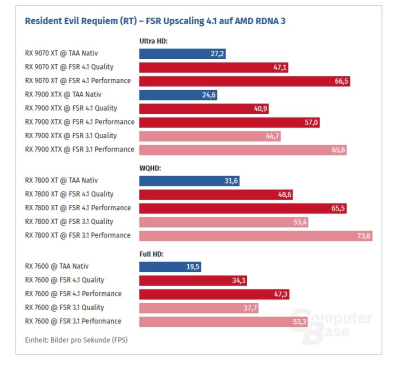
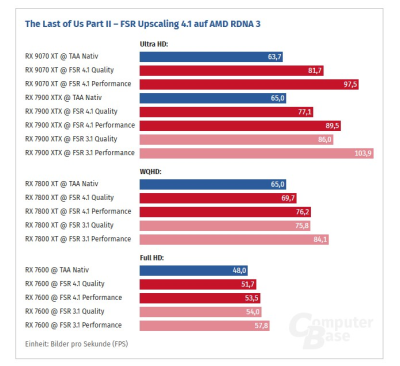
In essence, AMD has redefined the quality baseline for its users. Despite the nominal drop in FPS, the overall user experience is enhanced by the elimination of the shimmering and blurring characteristic of earlier upscaler versions. In an era where visual fidelity is becoming the priority, such a sacrifice in performance appears entirely justified.
 The Evolution of the Apple Home Ecosystem